8 Best Team Building Activities for Large Companies
Table of Contents
- Why Large-Group Team Building Fails (And How to Fix It)
- 1. Field Day Relays: High-Energy Team-Building Activities for Large Groups
- 2. The Marshmallow Challenge: Problem-Solving for Groups of 20 or More
- 3. Music Trivia and Karaoke Battles: How to Integrate Music Into Corporate Team-Building
- 4. Puzzle Relay Races: Indoor Team-Building Activities for Work
- 5. Icebreakers That Actually Work for Big Teams
- 6. Virtual and Hybrid Options for Distributed Teams
- How to Choose the Right Activity for Your Group
- Frequently Asked Questions
Last Updated: October 18, 2026
Why Large-Group Team Building Fails (And How to Fix It)
Most team building activities for large companies fail for one simple reason: the team building activities were designed for groups of 12 and then stretched to fit 200. The result is chaos, half the room watching while a handful of people play, and a nagging sense that everyone just lost an afternoon.
At TheMovement315, we have spent over two decades running events for corporate groups across Central New York, and we have watched this pattern play out more times than we can count. The fix is not more elaborate planning. It is picking activities built for scale from the start.
Large-group team building works when it is:
- Rotational so everyone moves, not watches
- Low-stakes so nobody fears looking foolish
- Time-boxed so energy stays high
- Role-rich so quiet people still contribute
Below, we break down eight activities that hold up with 20 people or 200, plus the planning details most guides skip.
1. Field Day Relays: High-Energy Team-Building Activities for Large Groups
Field day relays are the most reliable format for big corporate teams because they divide a crowd into small squads that compete side by side. Think sack races, three-legged races, egg-and-spoon races, tug-of-war, and obstacle courses.
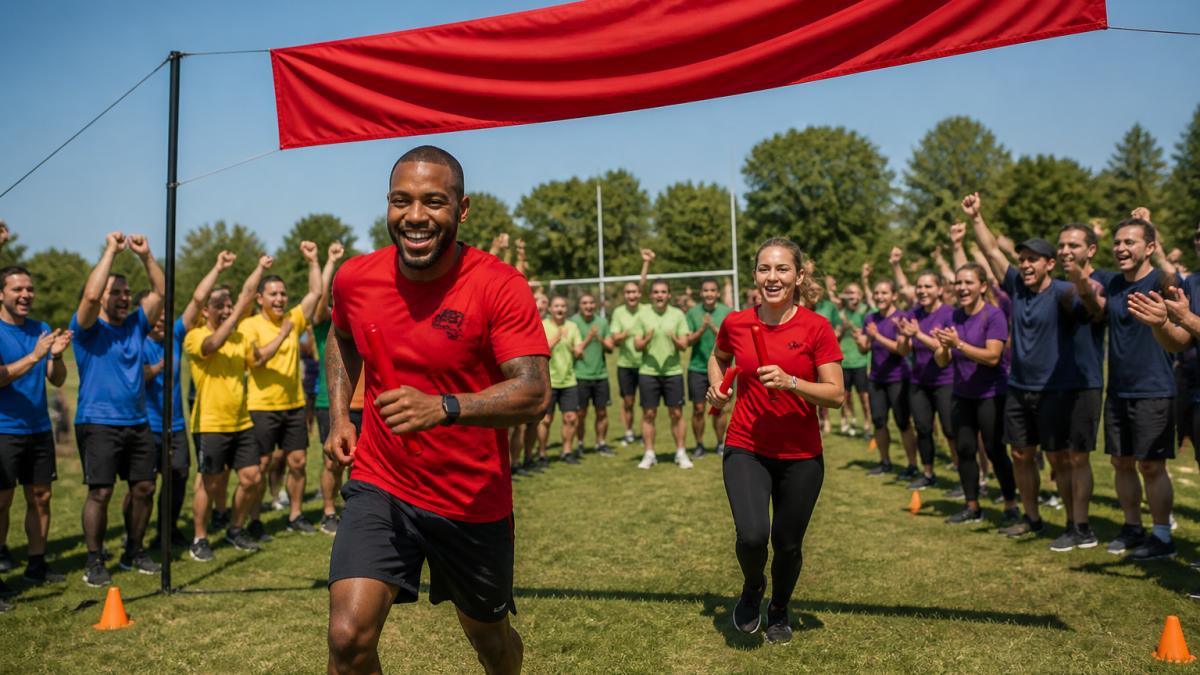
Here is how we would run it for 150 people:
- Split into 10 teams of 15 and assign a color to each.
- Set up 5 stations around a field or parking lot.
- Rotate teams every 8 minutes with a whistle.
- Award points per station, not just for speed.
- Close with a tug-of-war finale for the top two teams.
The key is the rotation. When teams rotate, no one sits idle, and the whole group stays in motion. Cornhole and giant Jenga work well as low-impact stations for anyone who wants a break from running.
2. The Marshmallow Challenge: Problem-Solving for Groups of 20 or More
The Marshmallow Challenge asks teams to build the tallest free-standing structure they can using spaghetti, tape, string, and a marshmallow on top. It scales beautifully because every team of four to six people gets their own kit.
For groups of 20 or more, run it in waves. Supply each table with materials and a timer. Give them 18 minutes, then measure every structure at once.
What makes this one of the strongest collaboration exercises is the debrief. Ask three questions:
- Who started building before planning?
- Who tested the marshmallow early?
- What would you do differently with five more minutes?
A common mistake is skipping the debrief. Without it, the game is fun but forgettable. With it, the lesson about prototyping and communication sticks.
3. Music Trivia and Karaoke Battles: How to Integrate Music Into Corporate Team-Building
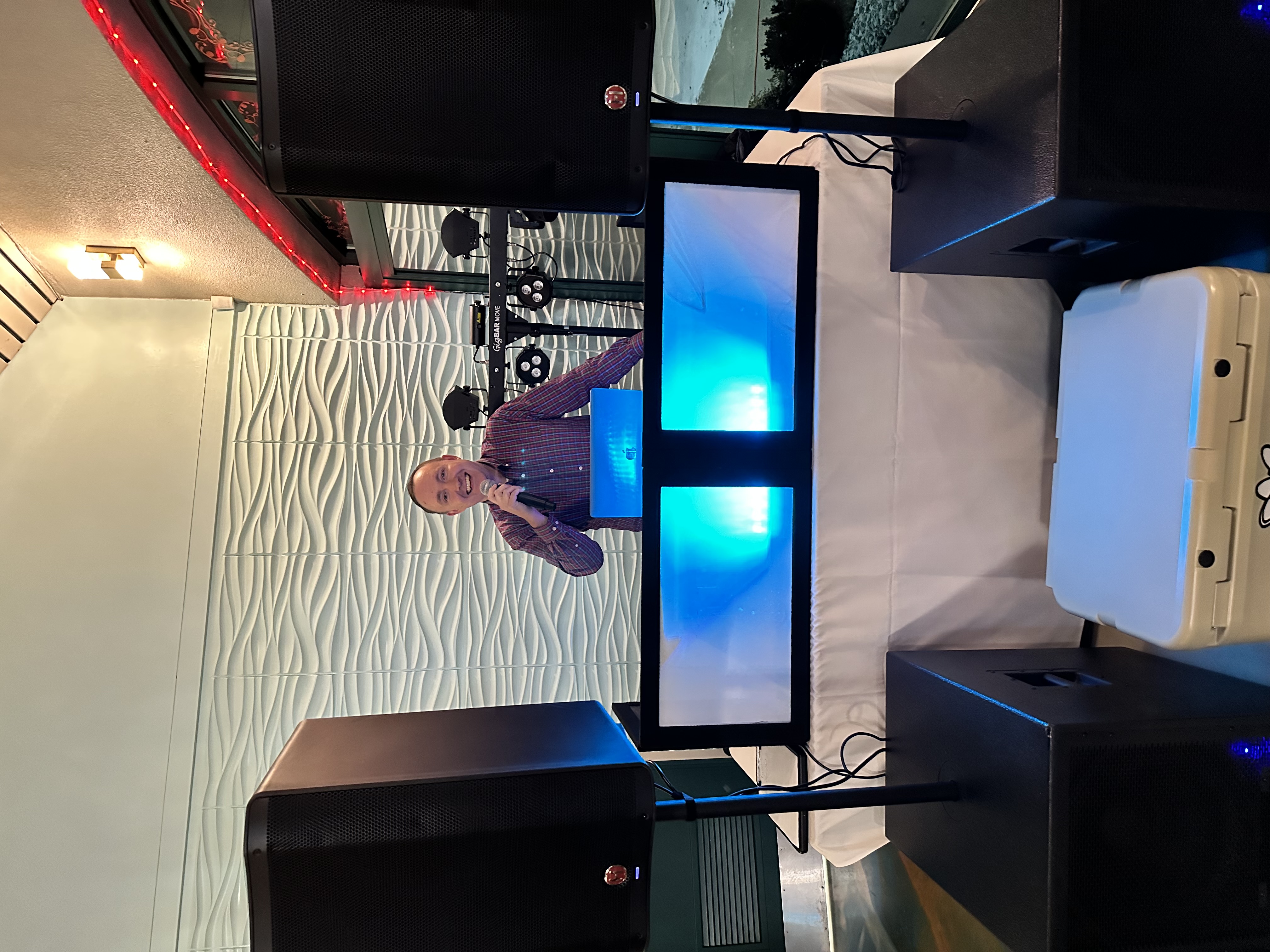
Music is the fastest way to lift morale in a big room, and it gives you two formats in one: a structured trivia round and a high-energy karaoke finish. This is where we at TheMovement315 do our best work, because sound, timing, and crowd reading are what we handle every week.
Here is a simple plan for integrating music into corporate team-building:
- Round 1: Name-that-tune trivia, 10 clips, teams write answers.
- Round 2: Decade battles, where each team picks a song from an assigned era.
- Round 3: Karaoke showdown, one volunteer per team, judges score on enthusiasm.
The thing nobody tells you about karaoke is that the crowd, not the singer, decides whether it works. A host who warms up the room and celebrates every performance turns a nervous moment into the highlight of the night. That is a big part of why we offer karaoke as an add-on to our DJ services.
4. Puzzle Relay Races: Indoor Team-Building Activities for Work
Puzzle relay races are indoor team-building activities for work that need almost no space. Teams solve a sequence of puzzles, and each solved puzzle unlocks the next clue.
Good puzzle types for large groups:
- Jigsaw stations with pieces split across tables
- Riddles posted on walls around the room
- Word and logic puzzles tied to company values
- A final group puzzle that needs every team's answer
With 100 or more people, run parallel tracks so multiple teams work at once. Keep each puzzle solvable in five minutes or less. The point is momentum, not difficulty.
5. Icebreakers That Actually Work for Big Teams
Most icebreakers fail at scale because they ask people to share personal details in front of a crowd. The ones that work are fast, paired, and a little playful.
Three that hold up with large groups:
- Two Truths and a Lie, speed edition. Pair people up, three minutes each, then rotate. No group sharing required.
- Common Ground Bingo. A grid of prompts like "has a pet" or "loves karaoke." First to a full row wins.
- Human Knot, small-squad version. Groups of eight tangle arms and untangle without letting go.
Each of these takes under 15 minutes and gets people talking to someone new. That is the whole goal of an icebreaker: lowering the stakes so the rest of the day flows.
6. Virtual and Hybrid Options for Distributed Teams
Distributed teams need activities that work on a screen without turning into a lecture. The best virtual formats mirror the in-person ones: short rounds, small breakout rooms, and a shared scoreboard.
Options that work well for remote participation:
- Virtual trivia with breakout teams and a live host
- Show-and-tell speed rounds where each person shares one object
- Collaborative drawing challenges on a shared whiteboard
- Remote karaoke with muted-audience cheers in the chat
For hybrid teams, run the same activity in the room and online at once, with one facilitator per side. The in-person group should never get a better version of the event than the remote one.
How to Choose the Right Activity for Your Group
Choosing well comes down to five variables: group size, time, budget, venue, and outcome. Use this table as a quick selection guide.
Activity | Best Group Size | Time Needed | Venue | Primary Outcome |
|---|---|---|---|---|
Field day relays | 50-300 | 2-3 hours | Outdoor or large hall | Morale, energy |
Marshmallow Challenge | 20-200 | 45-60 min | Any room with tables | Problem-solving |
Music trivia and karaoke | 30-300 | 1-2 hours | Room with sound system | Connection, fun |
Puzzle relay races | 20-150 | 60-90 min | Indoor space | Collaboration |
Icebreakers | Any size | 15-30 min | Anywhere | Getting to know you |
Virtual and hybrid games | 10-500 | 45-90 min | Online platform | Inclusion |
A few planning notes that matter:
- Accessibility: always offer a seated or low-mobility version of every physical challenge.
- Inclusion: avoid activities that require alcohol, singing solo, or sharing personal information.
- Logistics: book sound, space, and a rain plan before you book the activity.
- Measurement: send a two-question survey after the event asking about connection and enjoyment.
Frequently Asked Questions
How do you plan team-building activities for a large company?
Start by defining the goal: better communication, morale, or cross-department bonding. Then match the activity to your group size, venue, and time limit. For 100 or more people, choose stations or rotations so no one stands around waiting. Assign a facilitator or MC to keep energy up, confirm accessibility needs in advance, and build in music and breaks. Send a short pre-event survey so introverts and remote staff can opt into roles they are comfortable with.
What team-building activities work for groups of 20 or more?
Relay races, the Marshmallow Challenge, puzzle relays, music trivia, and karaoke battles all scale well because they split into small squads that compete against each other. The key is keeping squads to 6-10 people so everyone participates. For groups of 20 or more, run parallel stations and rotate every 15-20 minutes. Avoid activities that require one person to perform in front of the whole room unless participation is voluntary.
How can music be incorporated into corporate team-building activities?
Music works as both an energizer and a structure tool. Use a DJ or playlist to signal transitions between activities, pump up relay races, and run music trivia or karaoke rounds. Match the soundtrack to your crowd: mix decades and genres so every age group hears something familiar. A professional DJ can also handle MC duties, calling out scores and keeping the schedule moving so planners are not managing entertainment all night.
What are the 5 C's of team building?
The 5 C's are communication, collaboration, commitment, creativity, and conflict resolution. Strong activities hit at least two of these. Relay races build collaboration under pressure, the Marshmallow Challenge tests problem-solving and communication, and music trivia sparks creativity and shared commitment. When you evaluate an activity, ask which C it strengthens and whether the format gives every participant a real role rather than a spectator seat.
Pulling off team building activities for large companies takes more than a good idea. It takes sound, timing, and a host who can read a room of 150 people and keep them moving. That is exactly what TheMovement315 brings to every corporate event, with customized DJ services, professional MC duties, karaoke, and photo booths that give your team something to take home. Get a quote from TheMovement315 and let us handle the entertainment while you enjoy the event.