Corporate Event Atmosphere Tips for Product Launches
Table of Contents
- Start With a Clear Purpose: Goals and Success Metrics for Your Launch
- Sensory Atmosphere Design: Lighting, Sound, and Scent That Set the Tone
- Product Launch Event Ideas That Match Your Product Category
- Music for Corporate Events: Choosing the Right Soundtrack for Your Brand
- Guest Engagement Ideas for Corporate Events That Keep People Present
- Product Launch Event Agenda: Timing the Atmosphere From Arrival to Reveal
- Accessibility, Inclusion, and Budget Trade-Offs in Corporate Event Atmosphere
- Conclusion: Measuring Atmosphere and Getting It Right
- Frequently Asked Questions
Last Updated: October 14, 2026
Start With a Clear Purpose: Goals and Success Metrics for Your Launch
The best corporate event atmosphere tips for product launches start with one question: what should guests feel? Corporate event atmosphere is the blend of lighting, sound, scent, layout, and pacing that shapes how guests experience your brand. At TheMovement315, we've spent over two decades building that blend for corporate functions across Central New York.
Most launch events fail because planners chase a "wow" moment instead of a clear goal.
So define yours before you book anything:
- Product awareness: guests can describe the product in one sentence
- Lead generation: you collect a set number of qualified contacts
- Media coverage: a target number of press or influencer posts
- Sales: a specific number of demos or orders booked
Pick one primary goal. Two at most. Every atmosphere choice should serve it.
Sensory Atmosphere Design: Lighting, Sound, and Scent That Set the Tone
Atmosphere is not a mood board. It is a set of physical variables you can specify, measure, and adjust. Treat lighting, sound, scent, temperature, and materials as one system, and write each one down before you sign a venue contract.
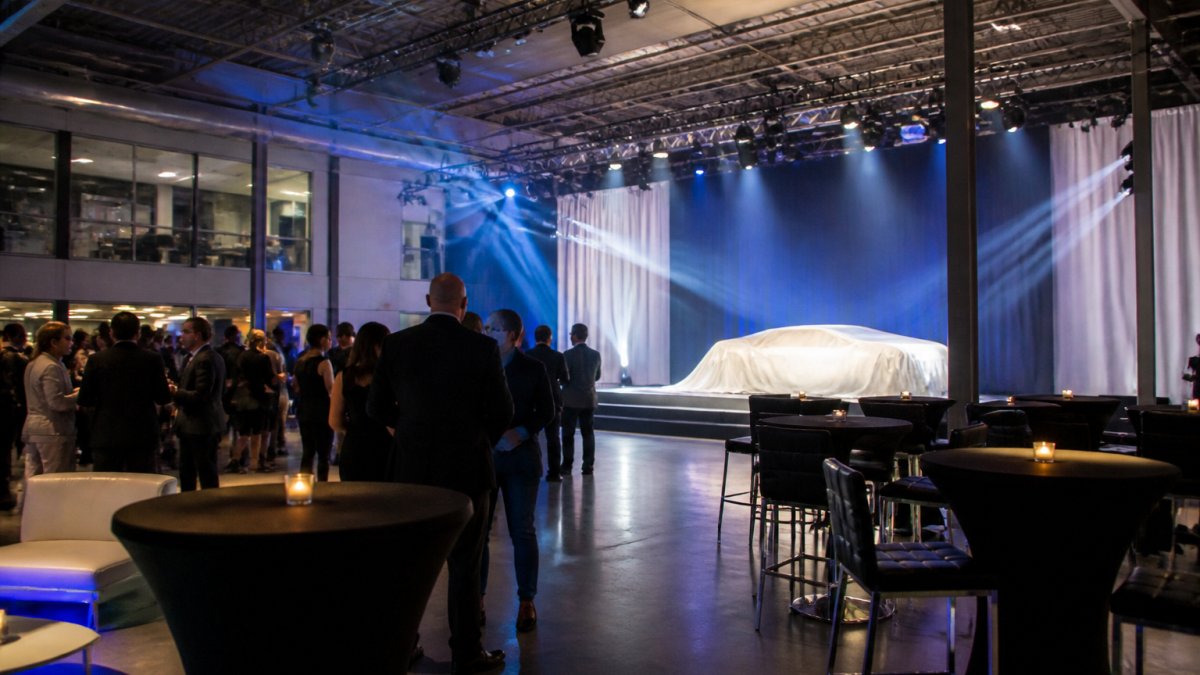
Lighting. Plan in layers, not a single setting. A common pattern is three layers: ambient (general wash), accent (product or stage), and task (paths, bars, demo stations). For a premium reveal, warm color temperatures in the 2700K-3000K range flatter skin tones and product photography. For a technical or software demo, 3500K-4000K reads cleaner on screens. Keep accent lighting at least 3:1 against ambient so the product pops without glare.
Sound. Set a target decibel range per zone and check it with a phone sound-meter app during setup. Conversation-friendly networking typically sits around 60-65 dB. A reveal moment can peak higher, but sustained levels above roughly 85 dB make conversation impossible and trigger fatigue. Place speakers so the demo area and the bar are not competing. If you have a live MC, give them a dedicated channel and a sound check before doors open.
Scent. Scent is optional and easy to overdo. If you use it, keep it subtle and confined to entry or a single zone. Skip it entirely when food, beverage, or fragrance products are being sampled, because scent competes with the product. Avoid strong florals in rooms with guests who have asthma or fragrance sensitivity.
Temperature and air. Rooms fill with body heat fast. Aim for 68-72°F at doors and expect it to climb. Ask the venue which zones share a thermostat, and confirm whether the HVAC can be adjusted mid-event. Stuffy rooms kill dwell time faster than bad decor.
Materials and layout. Soft surfaces (drapes, rugs, upholstered seating) absorb sound and feel warmer; hard surfaces (concrete, glass, metal) amplify noise and read as modern or clinical. Match the mix to your brand. Keep primary circulation paths at least 36 inches wide and demo stations spaced so guests can stand, watch, and step away without blocking traffic.
Sensory comfort and inclusion. Build in a quiet room or low-stimulation corner with softer light and lower sound, this helps guests with sensory sensitivities, nursing parents, and anyone who needs a break. Post clear directional signage at eye level. Offer non-alcoholic options equal in presentation to the bar. Provide captions on any video or screen content. These choices are rarely mentioned in launch-planning content, and they are the difference between a room that welcomes everyone and one that quietly excludes people.
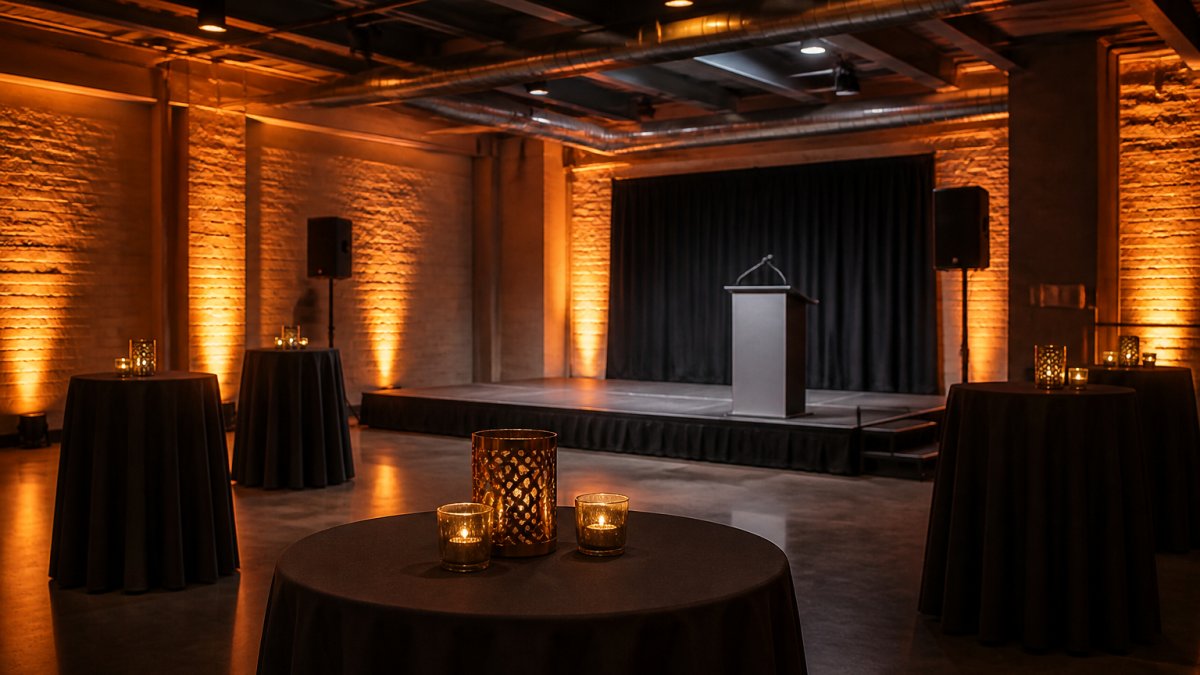
A common mistake is treating these as separate vendors. Lighting, sound, and HVAC should be cued from one run-of-show so the room shifts as a single system.
Product Launch Event Ideas That Match Your Product Category
The right atmosphere depends on two things, not one: the product category and the launch objective. A luxury reveal, a technology demo, a consumer sampling event, and a B2B press launch each want a different room, even when the product is similar.
Luxury or premium reveal. Fewer guests, lower light, slower pacing. Warm color temperature, soft materials, restrained music, and a single focal point. The product should be the brightest thing in the room. Avoid clutter, signage, and competing screens.
Technology or software demo. Brighter, cooler light. Multiple demo pods with reliable power and Wi-Fi. Low ambient music so people can talk through a workflow. Screens should be readable from standing distance, and each pod needs a clear owner who can run the demo repeatedly.
Consumer sampling (food, beverage, beauty). Warm light, upbeat but not overpowering music, and tasting or trial stations spaced to prevent lines. Keep scent neutral so it does not compete with the product. Provide napkins, water, and a place to set down samples.
B2B press or analyst launch. Controlled lighting for cameras, a clean backdrop, a defined stage, and a quiet area for interviews. Music should be minimal during remarks. Have a press kit and a clear demo path so media can capture the product without wandering.
Product Type | Atmosphere Move | Best For |
|---|---|---|
Software or app | Demo pods with screens, low ambient music, 3500K-4000K light | Hands-on trial |
Food or beverage | Tasting stations, warm lighting, upbeat playlist, neutral scent | Sensory memory |
Hardware or device | Draped reveal, spotlight, dramatic sound swell, dimmed room | Big reveal moment |
Service or platform | Storytelling stage, soft seating, acoustic set | Trust and connection |
Luxury or premium | Low light, warm tones, single focal point, restrained music | Exclusivity |
B2B press or analyst | Controlled lighting, clean backdrop, quiet interview area | Coverage and credibility |
The reveal itself should last under three minutes. Attention drops fast after that.
Budget trade-offs. Spend where guests look and listen: the reveal moment, the sound system, and the lighting. Save on printed decor, elaborate centerpieces, and one-use props. Low-cost upgrades that read as high-end include uplighting instead of a full venue redesign, a curated playlist instead of a live band, and one strong focal point instead of scattered decor. If the budget is tight, cut the number of atmosphere elements rather than the quality of each one.
Measuring whether the atmosphere worked. Atmosphere is observable. Track dwell time (how long guests stay past the program), demo-station participation, photo or content capture, and post-event survey scores on "how did the room feel." If people linger, talk, and try the product, the room is doing its job. If they leave right after the reveal, the atmosphere is not holding them.
Music for Corporate Events: Choosing the Right Soundtrack for Your Brand
Music for corporate events is not background noise. It's the emotional engine of the room. Get it wrong and the whole event feels off.
Start with these rules:
- Arrival: mid-tempo, instrumental, 90-110 BPM
- Networking: familiar, upbeat, low volume
- Reveal: one build-up track, timed to the moment
- Post-reveal: high-energy, recognizable hits
We always ask clients for a do-not-play list. It matters as much as the must-play list.
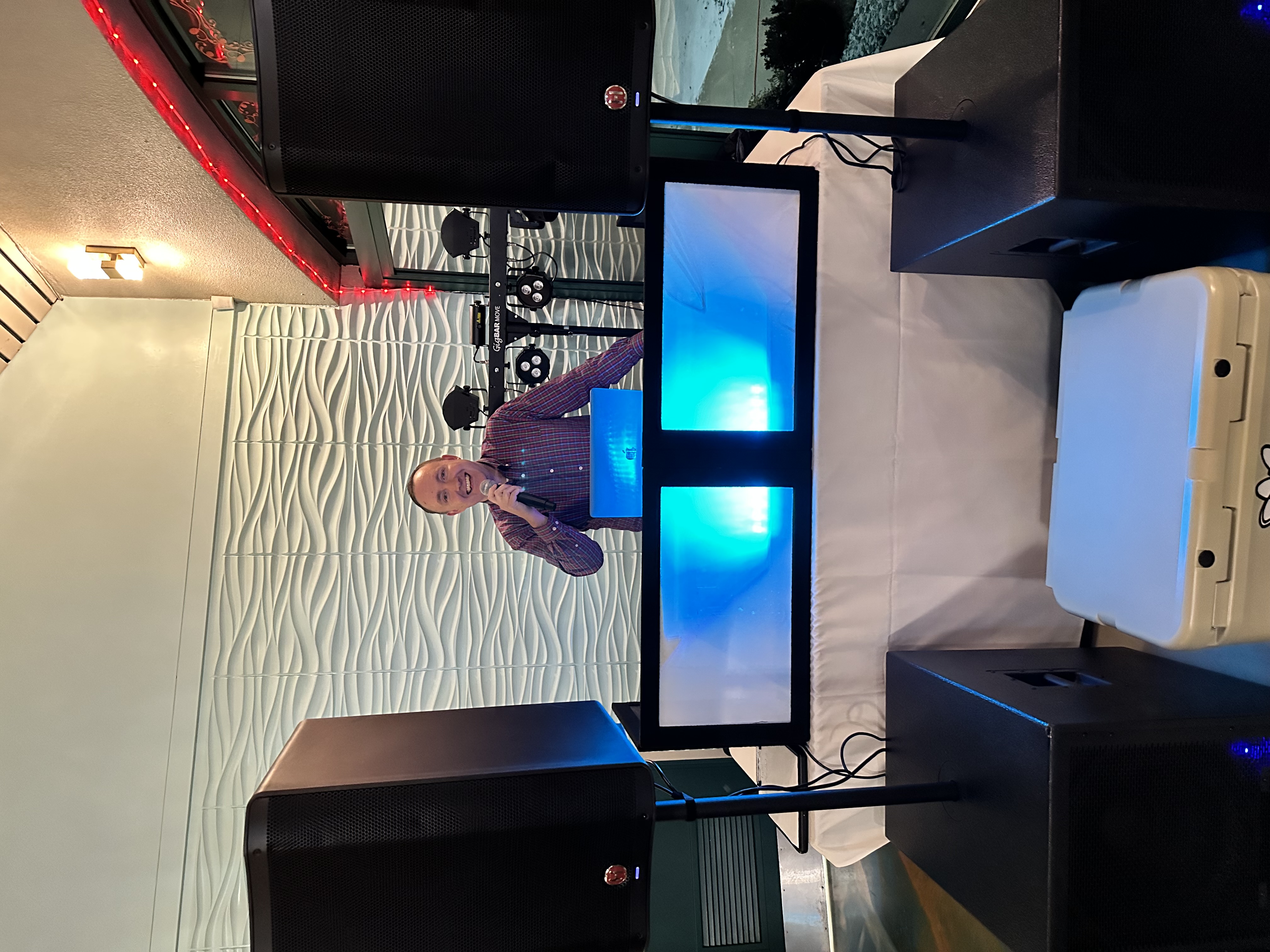
If you're booking a DJ, ask how they handle MC duties and timing. A good one keeps the agenda moving without you babysitting it.
Guest Engagement Ideas for Corporate Events That Keep People Present
Guest engagement ideas for corporate events work best when they give people something to do with their hands. Idle guests drift to their phones.
Try these:
- Photo booth with branded prints
- Karaoke corner for after the formal program
- Product demo challenge with a small prize
- Live poll displayed on a screen
- Networking bingo with conversation prompts
Interactive experiences beat passive ones every time. A photo booth gives guests a keepsake and gives you free social content.
The goal is presence, not just attendance.
Product Launch Event Agenda: Timing the Atmosphere From Arrival to Reveal
A product launch event agenda should time the atmosphere, not just the speakers. Here's a simple run-of-show we use:
- Arrival and check-in (30 min): ambient music, open bar, warm light
- Welcome and context (10 min): host intro, room settles
- Product reveal (3 min): lights shift, music swells, product shown
- Demo or hands-on (30 min): stations open, energy stays high
- Networking and food (45 min): upbeat playlist, photo booth open
- Closing remarks (5 min): thank-yous, clear next step
Build in 10 minutes of buffer. Something always runs long.
Accessibility, Inclusion, and Budget Trade-Offs in Corporate Event Atmosphere
Accessibility is not a nice-to-have. It's part of a professional room. Check these before the event:
- Clear paths for wheelchairs and walkers
- Seating for guests who can't stand long
- Captions on any video or screen content
- A quiet space for guests who need a sensory break
- Volume levels that don't overwhelm conversation
Budget trade-offs matter too. You don't need to spend big everywhere. Spend on the reveal, the sound, and the lighting. Save on decor that guests barely notice.
Low-cost wins:
- Uplights instead of full venue redesign
- A curated playlist instead of a live band
- One strong focal point instead of scattered decor
ADA venue accessibility guidance sets the baseline for public events. Plan for it early, not as an afterthought.
Conclusion: Measuring Atmosphere and Getting It Right
You can measure atmosphere. Track guest dwell time, photo booth usage, social posts, and post-event survey scores. If people stayed past the program, the room worked.
Getting atmosphere right takes experience. TheMovement315 brings over 20 years of customized DJ services, MC support, photo booths, and karaoke to corporate launches across Central New York. We handle the soundtrack and the energy so you can focus on your product. Get a quote and let us set the tone for your next launch.
Frequently Asked Questions
How do you create a memorable atmosphere at a product launch?
Memorable atmosphere comes from consistency. Pick one mood, then carry it through lighting, music volume, scent, and even the temperature of the room. If your product is playful, use bright colors and upbeat music. If it's premium, use warm dim lighting and low-volume jazz. The key is that every sensory choice reinforces the same feeling. Guests remember how a room made them feel, not the specific playlist, so aim for a unified impression rather than a series of disconnected effects.
What music works best for a corporate product launch?
The best music matches your brand voice and shifts with the event agenda. During arrival, use instrumental tracks at low volume so guests can talk. During the reveal, switch to something with more energy and a clear beat to signal the moment. After the reveal, move into familiar upbeat songs that encourage mingling. Avoid lyrics that could distract from a speaker or clash with your brand. A professional DJ can read the room and adjust in real time, which a static playlist cannot do.
How long should a product launch event last?
Most corporate product launches run two to three hours. Arrival and networking typically take 30 minutes, the presentation and reveal take 30 to 45 minutes, and the remaining time is for demonstrations, food, and informal conversation. If you add entertainment like a photo booth or karaoke, plan for at least 30 extra minutes. Going past three hours risks losing energy unless you have a strong reason, such as a full dinner program or an awards segment. Match the length to your agenda, not the other way around.
How do you keep guests engaged during a product launch?
Engagement starts before the reveal. Give guests something to do when they arrive, such as a photo booth, a hands-on demo station, or a short interactive poll. During the presentation, keep segments under 10 minutes each and vary the format between speakers, video, and live demonstration. After the reveal, create small-group activities like guided product trials or a karaoke corner. The goal is to give people a reason to stay, talk, and participate rather than just watch.