High Quality Photo Booth Rentals: 2026 Buyer's Guide
Table of Contents
- Why High Quality Photo Booth Rentals Matter for Your Event
- What Separates Professional Booths From Budget Setups
- Photo Booth Types: Open-Air, Enclosed, and 360-Degree Video
- Camera, Lighting, and Print Quality: The Technical Checklist
- Is a Photo Booth Worth It for School Dances?
- Photo Booth Rental Pricing Guide: What Drives the Cost
- Questions to Ask Photo Booth Vendors Before You Sign
- Frequently Asked Questions
Last Updated: September 10, 2026
Why High Quality Photo Booth Rentals Matter for Your Event
Choosing high quality photo booth rentals comes down to one question: will your guests actually use it, or will it sit ignored in a corner all night? The difference between a booth that draws a line and one that collects dust usually isn't the theme or the props. It's the equipment, the lighting, and the attendant running it.
This guide covers what separates professional setups from budget ones, how to match a booth to your venue, what drives pricing, and the contract terms worth reading twice.
Here's the part most guides skip: a photo booth rental is a piece of technical equipment with power needs, space requirements, and a service agreement attached. Treat it like booking a vendor, not ordering a party favor.
What Separates Professional Booths From Budget Setups
Professional booths use DSLR or mirrorless cameras, studio-quality lighting, and dye-sublimation printers (imaging.org). Budget setups often rely on tablets with built-in cameras and no external flash. The gap shows up in every photo.
A common mistake is judging a booth by its photo strip design instead of its hardware. Ask what camera body and lens the vendor uses, how they light the shot, and how fast prints come out. Consumer-grade setups produce grainy, dim images the moment the room lights drop for dancing.
Photo Booth Types: Open-Air, Enclosed, and 360-Degree Video
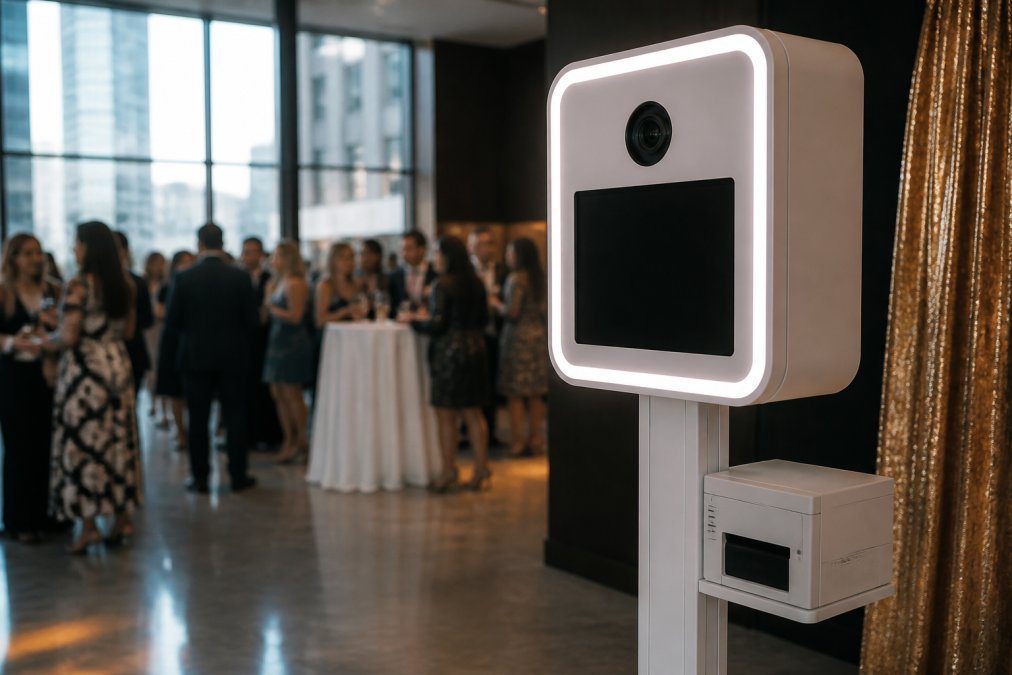
Three formats dominate the market, and each fits a different room and crowd. An open-air booth uses a backdrop and freestanding camera on a tripod, so groups of eight or more can fit in frame. An enclosed booth offers a curtained private space that some guests prefer. A 360-degree video rig spins a camera around the subject for a slow-motion clip built for social media.
Booth Type | Best For | Guest Capacity | Space Needed |
|---|---|---|---|
Open-air | Large groups, branded events | 8-12 people | Wide wall or corner |
Enclosed | Private, intimate moments | 2-6 people | Enclosed footprint |
360-degree video | Social media, younger crowds | 1-4 people | Open circular area |
Matching the Booth Type to Your Guest Count and Venue Footprint
Match the booth to your venue footprint before anything else. A 360-degree rig needs an open circular area with clearance for the arm to spin. An enclosed booth needs a dedicated footprint plus power access. Open-air setups are the most flexible and work in almost any room with a blank wall.
For a 150-guest corporate party, an open-air booth with an onsite technician keeps the line moving. For a smaller anniversary dinner, an enclosed booth feels more intimate.
Camera, Lighting, and Print Quality: The Technical Checklist
Run this checklist before you book, and you'll filter out most low-quality vendors in one conversation.
- Camera: DSLR or mirrorless, not a tablet or webcam
- Lighting: studio-quality flash or a ring light, not ceiling fixtures alone
- Printing: dye-sublimation, with prints ready in under 20 seconds
- Resolution: high enough for a clean 4x6 print, not just a screen image
- Sharing: digital sharing by text, email, or QR code, plus a cloud gallery
- Customization: custom photo templates and a custom backdrop

The thing nobody tells you about print quality is that instant printing speed matters as much as sharpness. If a booth takes a minute per print, the line stalls and guests walk away.
Is a Photo Booth Worth It for School Dances?
A photo booth is worth it for school dances when the goal is guest engagement and a keepsake students actually take home. Many schools find it gives students something to do beyond dancing, which matters at events where mixed groups and wallflowers need an icebreaker.
Administrators should ask about prop selection and content moderation. A booth with AI modifiers and filters needs a setting that keeps images appropriate for a school audience. Confirm the vendor can disable anything questionable before the event.
Photo Booth Rental Pricing Guide: What Drives the Cost
Photo booth rental pricing is not a flat hourly rate. Most vendors quote a bundled package, setup, an attendant, a set number of rental hours, and a defined print or digital allowance, then layer on fees for anything outside that bundle. Understanding how the bundle is built is the only way to compare two quotes that look identical on the surface.
Here is how a typical quote breaks down:
- Base rental window. Usually a 2- to 4-hour block. Anything past the block is billed as overtime, often in 30- or 60-minute increments.
- Idle time. Some vendors charge for the hours the booth sits unused between the ceremony and the reception. Ask whether idle time is billed at full rate, half rate, or not at all.
- Booth type. A 360-degree video rig carries more equipment, more setup labor, and a higher base rate than an open-air or enclosed booth.
- Attendant and technician. A dedicated onsite attendant is usually included; a separate technician for 360 rigs or multi-booth setups may be a line item.
- Customization. Custom photo templates, branded backdrops, and custom prop sets are typically add-ons, not inclusions.
- Travel and load-in. Vendors commonly set a service radius, often 25 to 50 miles, and bill mileage or a flat trip fee beyond it. Load-in time may or may not count against your rental window.
- Print and digital allowances. Unlimited prints, capped print counts, and cloud gallery storage windows all affect the number.
- Add-ons. AI modifiers, extra props, guest book albums, and additional hours are priced individually.
How to Compare Two Quotes Without Getting Fooled
Advertised rates are teasers. A written quote is the only number that matters, and two quotes are only comparable when they cover the same scope. Build a one-page comparison sheet with these rows:
- Rental window and overtime rate
- Idle-time policy
- Booth type and equipment list
- Attendant hours and whether a technician is included
- Print allowance and digital gallery retention
- Travel radius and trip fee
- Load-in and load-out time, billed or not
- Deposit, cancellation, and reschedule terms
A quote that looks cheaper almost always differs on one of these rows. The most common trap is a low base rate paired with a short rental window and a steep overtime rate, which costs more the moment your event runs long.
The Sustainability Clause That Affects Price
Print-heavy booths consume paper and dye-sublimation ribbon, and some vendors pass recycling or cartridge-disposal costs through. A digital-only configuration, sharing by text, email, or QR code with a cloud gallery, usually lowers the per-hour rate because it removes consumables and printer maintenance from the equation. If your event is eco-conscious or your guest list skews younger, ask for a digital-first quote alongside the standard print package and compare the two side by side.
Questions to Ask Photo Booth Vendors Before You Sign
Ask these questions and you will separate vendors who own their equipment and staff their events from resellers who subcontract both. The answers matter more than the brochure.
- What camera body and lens do you use, and is it DSLR or mirrorless?
- What is your lighting rig, external flash, strobe, or ring light?
- Is an attendant on site for the full rental window, or only for setup?
- What are the power requirements, and who provides the circuit?
- How long is load-in, and does it count against my rental time?
- How does digital sharing work, text, email, QR code, or all three?
- What is the cloud gallery retention window, and can I download everything?
- What happens if a printer, camera, or internet connection fails mid-event?
- Who owns the photos after the event, and can you use them in marketing?
- What is your backup plan if the assigned attendant cannot make it?
Contract Red Flags: A Must-Have Checklist
Most rental agreements are written to protect the vendor. That is normal. What is not normal is a contract that leaves you exposed on the four terms below. Read every agreement against this checklist before you sign.
1. Data ownership and marketing rights. The default in many contracts is that the vendor retains the right to use your guests' images for portfolio, social media, and advertising. If you want that restricted, it must be stated in writing. Look for a clause that names you as the owner of the captured files and requires written permission before any image is used publicly.
2. Retention and delivery window. A contract that says photos are "available in the cloud" without a stated retention period is a red flag. Ask for a specific number of days or months, and confirm the format, full-resolution downloads, not just compressed previews. A common pattern is a 30- to 90-day gallery window, after which files are purged (nist.gov). If you need longer, negotiate it into the agreement.
3. Contingency and backup equipment. A professional agreement names what happens when hardware fails: a backup printer, a spare camera body, an onsite technician, or a stated remedy such as a partial refund or extended hours. A contract with no failure clause leaves you with no leverage if the booth dies at 9 p.m.
4. Cancellation, reschedule, and force majeure. Confirm the deposit amount, whether it is refundable, how far in advance you can reschedule without penalty, and what happens if the venue loses power or the event is postponed. Weather, venue closures, and public-health disruptions are common force majeure triggers, make sure the clause is mutual, not one-sided.
Post-Event Data: What You Should Walk Away With
After the event, you should receive three things in writing: a download link or gallery URL, the retention window for that gallery, and confirmation of who owns the files. If your vendor offers a guest book album, confirm whether it is printed onsite or shipped later, and whether the digital files that feed it are included in your download.
For corporate events, add one more question: can the vendor provide a usage license for the images so your marketing team can repurpose them without a separate release? Getting that answer before the event prevents a follow-up negotiation weeks later.
Frequently Asked Questions
How much should you expect to pay for a premium photo booth rental?
Pricing for photo booth rentals depends on rental duration, booth type, customization, and add-ons like AI modifiers or 360-degree video. A basic setup costs less than a fully staffed open-air booth with instant printing and custom templates. Travel distance and peak dates also affect the total. Request itemized quotes from at least three vendors and compare what each package includes before deciding.
What features distinguish a high quality photo booth from a budget option?
High quality photo booth rentals typically include a DSLR camera, studio-quality lighting with a ring light or flash, instant printing, digital sharing options, and an onsite technician. Budget setups often rely on tablet cameras, weak lighting, and no attendant, which produces blurry, poorly lit images. Ask vendors to specify their camera model, lighting setup, and image resolution before you book.
What questions should I ask photo booth vendors before booking?
Ask about camera and lighting equipment, rental duration and load-in time, attendant service, power requirements, and whether setup is included. Confirm the booking deposit amount, cancellation policy, and who owns the images after the event. Request a copy of the service agreement and check for hidden fees like travel charges or overtime. These questions to ask photo booth vendors prevent surprises on event day.
Is a photo booth worth it for school dances and proms?
A photo booth gives students a screen-free activity that keeps them engaged throughout the event. It creates personalized keepsakes, encourages group photos, and adds structure to the evening. Schools should confirm the vendor offers appropriate prop selection, data privacy protections for minors, and a service agreement that covers chaperone oversight. When the equipment is professional-grade, the booth becomes a highlight students remember.