How to Choose Wedding Music: Ceremony to Reception
Table of Contents
- Start With the Wedding Ceremony Song Timeline
- Live Musicians vs. a DJ: What Fits Your Venue
- How to Build Your Must-Play vs Do-Not-Play Wedding List
- Set Your Wedding DJ Song Request Policy Before the Day
- Wedding Reception Playlist Ideas That Keep Every Age Dancing
- The Technical Checklist: Sound, Volume, and Venue Acoustics
- Frequently Asked Questions
Last Updated: September 13, 2026
Start With the Wedding Ceremony Song Timeline
Learning how to choose wedding music gets much easier once you stop thinking in songs and start thinking in moments. A wedding ceremony has three distinct musical slots, and each one does a different job: the prelude (guest arrival, 15-30 minutes), the processional (wedding party and partner entrances), and the recessional (the celebratory exit). TheMovement315 has over two decades of experience elevating events across Central New York, and the couples who map these three slots first never scramble later.
The wedding ceremony planning guidance from Brides makes the same point: the ceremony soundtrack is a sequence, not a playlist.
Prelude, Processional, and Recessional Slots
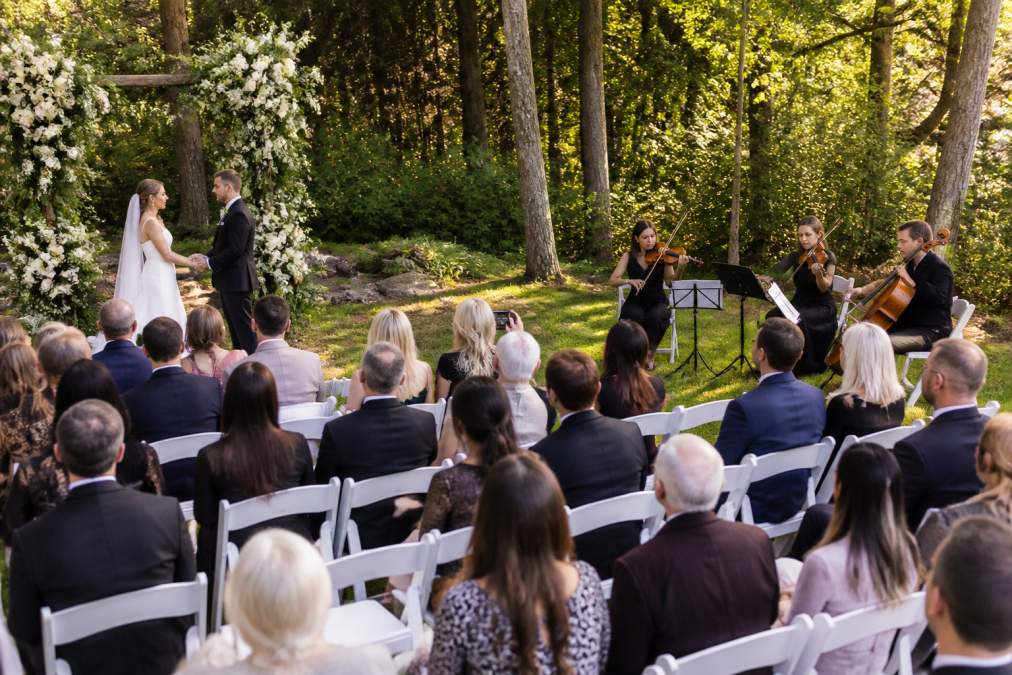
The prelude sets the mood while guests find seats. Instrumental tracks work best here because people are talking over them. The processional covers every entrance, from grandparents to the wedding party to the person walking the aisle. The recessional is one upbeat track that carries everyone back down the aisle and into cocktail hour.
Matching Tempo to Walking Pace
Tempo is where most couples get surprised. A song that feels romantic on your couch can drag painfully during an aisle walk. A common mistake is choosing a slow ballad for the processional, then watching the wedding party shuffle awkwardly to keep time (brides.com).
The fix is simple: aim for roughly 70-90 beats per minute for the processional, and don't be afraid to have your DJ or musicians nudge the tempo up slightly. Faster walk, faster music. Slower walk, slower music.
Live Musicians vs. a DJ: What Fits Your Venue
Live musicians and DJs solve different problems, and the right answer depends on your venue as much as your taste. A string quartet or solo acoustic guitarist brings unmatched atmosphere to a ceremony, but needs space, setup time, and acoustic conditions that work in their favor. A DJ covers the entire wedding day, from prelude to last dance, with one vendor and one sound system.
Here's the practical breakdown:
Option | Best For | Watch Out For |
|---|---|---|
Live musicians | Outdoor and religious ceremonies, intimate guest counts | Rain, wind, and power access outdoors |
DJ | Full-day coverage, receptions, mixed-age crowds | Needs a reliable power source and load-in time |
Hybrid | Ceremony live, reception DJ | Two vendors, two setup windows |
If you're booking a DJ, ask directly how they handle ceremony audio. Many couples assume the reception DJ automatically covers the ceremony, then discover it's a separate setup. For a mixed-age wedding with grandparents and college kids, a DJ who can move between genres without an awkward gear change is worth more than a longer song list.
What Each Option Actually Costs You
Live musicians are usually quoted per player, per hour, with a minimum block. A solo guitarist or harpist typically books in two- to three-hour windows that cover prelude, processional, and recessional, while a quartet often carries a higher minimum because four people are blocking the same afternoon. A DJ is usually quoted as a flat package that includes ceremony sound, reception coverage, and an MC, which is why the per-hour math can look cheaper even when the total is higher.
The trade-off isn't just money. Live musicians can't easily extend past their booked block, and they can't pivot to a dance set after dinner. A DJ can stretch from prelude to last call with one contract, but you lose the acoustic texture that makes a ceremony feel like an event rather than a playlist.
The Hybrid Setup Most Couples Land On
The most common pattern is live musicians for the ceremony and cocktail hour, then a DJ for the reception. That gives you the acoustic warmth where guests are seated and listening, and the flexibility where guests are dancing and requesting. The catch is the handoff: you need a clear load-out window for the musicians and a load-in window for the DJ, and those windows can't overlap with your cocktail hour if the same space is being used.
If your ceremony and reception are in the same room, ask both vendors to walk the space together before the day. A five-minute conversation about where the quartet sits and where the DJ's speakers go prevents the awkward moment where one vendor is unplugging while the other is setting up.
Questions to Ask Before You Sign
- How many hours does the quote actually cover, and what does an extra hour cost?
- Does the price include ceremony sound, or is that a separate line item?
- Who provides the microphones for the officiant and any readers?
- What happens if a musician is sick or a speaker fails mid-ceremony?
- Can the DJ or band handle a live-stream or recording feed if you have remote guests?
Those five answers will tell you more about fit than any sample playlist.
How to Build Your Must-Play vs Do-Not-Play Wedding List
The must-play vs do-not-play wedding list is the single document that protects your taste from being overruled. It's not a full playlist. It's a short, firm list of songs that must play and songs that must never play, plus a handful of artists who define your vibe.
Keep each side to 10-15 entries. A list of 80 must-plays gives your DJ no room to read the room, and reading the room is the whole job.
A common mistake is treating the do-not-play list as optional. It isn't. If a song reminds you of an ex, a family conflict, or a genre you genuinely can't stand, write it down. Your DJ would rather know than guess.
Set Your Wedding DJ Song Request Policy Before the Day
Your wedding DJ song request policy is the rule you hand your DJ about how to handle requests from guests. Without one, you get two bad outcomes: a DJ who plays every request and loses the dance floor, or a DJ who ignores everyone and kills the mood.
Decide in advance:
- Can guests request songs directly, or only through you?
- Are there genres or artists that are off-limits no matter who asks?
- Should the DJ take over completely after a certain hour?
Most couples land on a middle ground: guests can request, the DJ uses judgment, and the do-not-play list is absolute. Put it in writing in your booking agreement so there's no confusion on the night.
Wedding Reception Playlist Ideas That Keep Every Age Dancing
The best wedding reception playlist ideas follow one rule: sequence, not selection. You can play great songs in the wrong order and empty the floor. You can play average songs in the right order and keep it packed.
Build the night in blocks. Start with dinner-friendly background tracks, move into a nostalgia block that pulls older guests up, then shift into current hits for the younger crowd, and close with a singalong block everyone knows.
The Technical Checklist: Sound, Volume, and Venue Acoustics
Audio quality decides whether your ceremony feels polished or amateur, and it's the part most planning guides skip. Venue acoustics vary wildly: a stone chapel echoes, a tent swallows sound, an open field carries it away. Your DJ or musicians need to know which one they're walking into.
How Each Venue Type Changes Your Sound Plan
Indoor spaces with hard surfaces, stone chapels, marble lobbies, glass-walled rooms, reflect sound. A single microphone can pick up its own echo, and a string quartet can sound muddy if it's placed against a back wall. The fix is usually to move the musicians off the wall and toward the guests, and to keep the officiant's mic gain lower than you would outdoors.
Tents and draped ballrooms, fabric absorbs high frequencies. Vocals and acoustic guitar lose their brightness, so a microphone that sounded fine in a rehearsal can sound dull on the day. Ask your DJ to add a small amount of high-frequency boost to the officiant's channel, and place speakers closer to the back row than you would in a chapel.
Open fields and waterfronts, sound has nothing to bounce off, so it dissipates. You need more speaker coverage, not more volume. Two smaller speakers placed apart usually beat one large speaker cranked up, because the goal is even coverage rather than a loud center point.
Wind is the outdoor wildcard. A foam windscreen on every microphone is cheap insurance, and a lavalier clipped to the officiant's collar is more wind-resistant than a handheld.
The Equipment That Actually Matters
You don't need a studio. You need four things working correctly:
- A microphone for the officiant, handheld or lavalier, with a windscreen if you're outdoors
- A microphone for readers, a second channel, or a handheld passed between them
- Speakers with even coverage, placed so the back row hears the vows as clearly as the front
- A mixer or controller, so volume can be adjusted live without walking to the speaker
If you're hiring a DJ, confirm all four are included in the ceremony quote. If you're going DIY, a small powered speaker with a built-in mixer and a wired microphone will cover most ceremonies under 100 guests, and a battery-powered option removes the need for a nearby outlet.
Volume Levels by Moment
Volume control matters more than people expect, and each part of the ceremony has a different target:
- Prelude: low enough that guests can talk over it without raising their voices
- Processional: loud enough to be felt, not so loud that it drowns the officiant's opening words
- Vows and readings: clearly audible to the back row, which is usually the test you run at sound check
- Recessional: the one moment you can open up, because guests are cheering and moving
Your Pre-Day Sound Check
Work through this before the day:
- Confirm power access at the ceremony site, not just the reception
- Walk the space with your DJ to test microphone coverage from the back row
- Set volume levels for the prelude, vows, and recessional separately
- Agree on a sound check window before guests arrive
- Have a backup plan for wind, rain, or a failed speaker
- Test any live-stream or recording feed at the same time as the room mix
For couples who want a personalized keepsake beyond the music, add-ons like a photo booth give guests something to take home. Pricing depends on your date, guest count, and package, so request a quote.
Choosing wedding music is really a logistics problem wearing a romantic costume. The couples who nail it aren't the ones with the longest playlists; they're the ones who mapped their ceremony timeline, set a clear request policy, and thought about sound before songs. TheMovement315 has spent 20+ years building customized soundtracks for weddings and private celebrations across Utica, Syracuse, and Central New York, with pressure-free phone consultations, MC support, photo booth keepsakes, and karaoke add-ons. Get a quote from TheMovement315 and let someone who does this every weekend handle the music so you can stay in the moment.
Frequently Asked Questions
What are some good ways to choose a wedding song?
Start with the moment it serves. Your processional needs a steady tempo for walking, while your reception entrance can be upbeat. Pull from songs that already mean something to you as a couple, then check that the lyrics and pacing fit the setting. A DJ or bandleader can help you test how a track feels in the actual room before you lock it in.
Who picks the bride's entrance song?
Traditionally the person walking down the aisle chooses the song, though many couples pick it together during planning. If you are working with a DJ, share two or three options and let them flag timing issues, like a track that runs long or starts too slow. Give the officiant and sound operator the final version at least two weeks ahead so cues stay clean.
How do you balance music tastes for a diverse wedding crowd?
Build your must-play list around songs that pull different age groups onto the floor, then schedule them in blocks. Open with Motown or classic rock for older guests, shift to current pop and hip-hop for the younger crowd, and close with crowd-pleasers everyone knows. A wedding DJ song request policy that allows guest requests during open dancing helps fill gaps you did not plan for.
Should you use a live band or a DJ for your wedding?
It depends on your venue and budget. Live musicians, like a string quartet or full band, add a rich acoustic sound for the ceremony and cocktail hour but need space, power, and setup time. A DJ covers more musical ground, handles MC duties, and adapts to the crowd in real time. Many couples use both, with live music for the ceremony and a DJ for the reception.