How to Integrate Music into Corporate Team Building
Table of Contents
- Why Music Belongs in Your Corporate Team Building Plan
- Corporate Team Building Music Activities That Actually Work
- Music-Based Icebreakers for Meetings and Workshops
- Hiring a DJ for Corporate Events: What to Look For
- How to Run a Music Workshop for Remote Teams
- Measuring the ROI of Music in Corporate Team Building
- Conclusion
- Frequently Asked Questions
Last Updated: September 27, 2026
Why Music Belongs in Your Corporate Team Building Plan
Music is one of the fastest ways to break down walls between coworkers. It works because rhythm and melody tap into the same social wiring that helps people sync up, listen, and cooperate. This guide from TheMovement315 covers how to integrate music into corporate team building without a huge budget or a music degree.
The case for music is simple. It changes the room in seconds. A stiff conference space becomes a place where people relax, laugh, and take part.
Most team building fails for one reason: it feels like homework. People dread it. Music flips that script. It gives everyone a shared job, a shared beat, and a shared win.
You do not need talent to take part. You need a facilitator, a plan, and the right room setup.
The five activities below are easy to run and hard to forget. Here is how to start.
American Psychological Association research on music and social bonding
Corporate Team Building Music Activities That Actually Work
The best corporate team building music activities mix low pressure with a clear goal. Pick activities that let everyone join in, not just the confident performers. Keep each one short, then debrief.
Rhythm Circles and Group Drumming
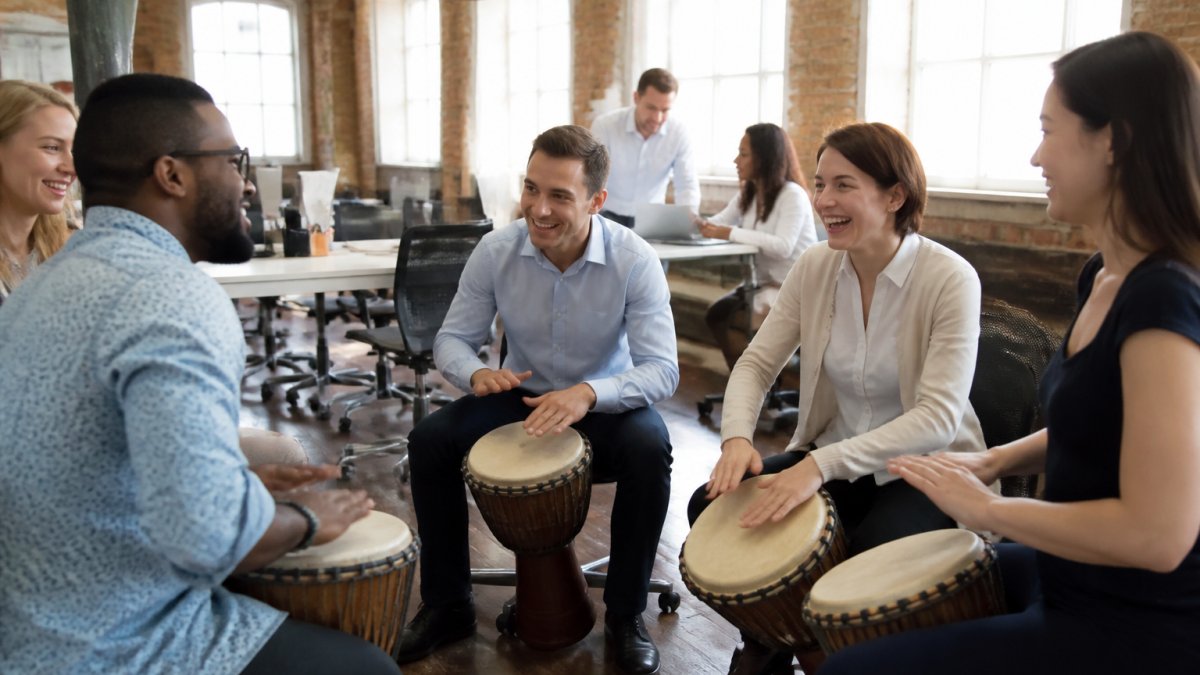
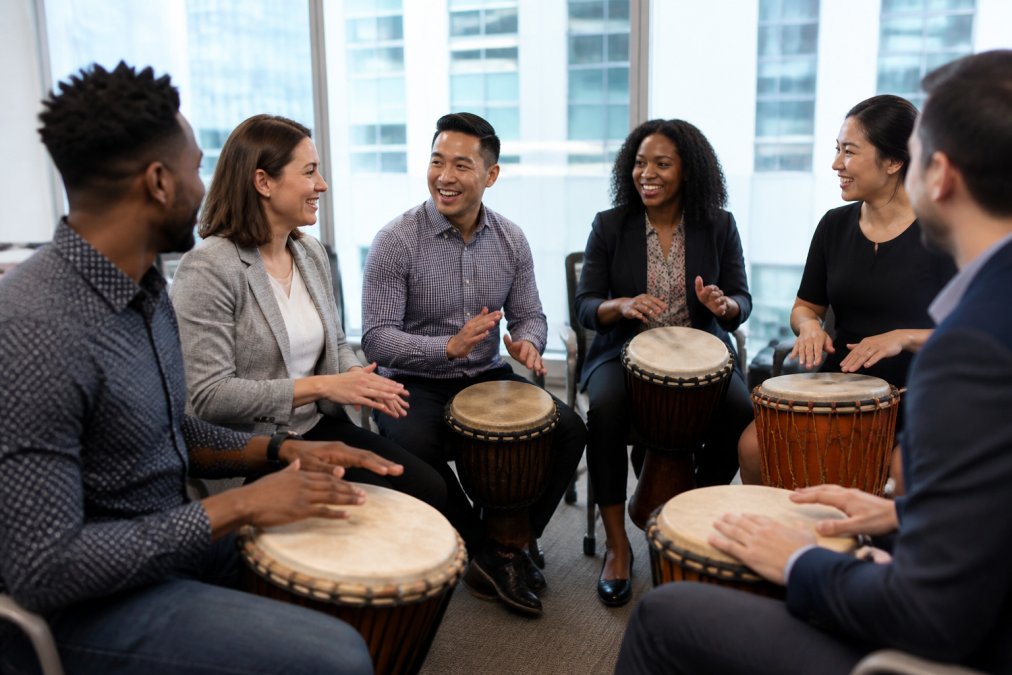
A rhythm circle is a group drumming session where everyone plays a simple part that locks into one shared beat. No skill is needed. The facilitator sets the pulse and layers people in.
Here is how to run one:
- Set up chairs in a circle with a drum or shaker at each seat.
- Teach one basic pulse: "one, two, three, four."
- Split the group. One side keeps the pulse, the other claps off-beat.
- Add layers one at a time until the whole room is playing.
- End on a clean stop, then ask what it felt like.
The lesson lands fast. If one person rushes, the group hears it. If everyone listens, the sound locks in.
Playlist Battle and Song Trivia
A playlist battle splits the room into teams that each build a short set around a theme. Song trivia does the same thing with guessing games. Both turn music knowledge into a team sport.
Try these formats:
- Decade battle: each team gets a decade and picks three songs.
- Name that tune: play a few seconds and let teams buzz in.
- Soundtrack your team: teams pick a theme song for their department.
Keep songs clean and workplace-appropriate. Screen every track before the event.
Music-Based Icebreakers for Meetings and Workshops
Music-based icebreakers for meetings are short, low-stakes games that use sound to help people open up. They work in five minutes and need no equipment beyond a phone or speaker.
Try one of these at your next workshop:
- Two truths and a track: each person shares a song that fits their week.
- Human jukebox: call out a mood, and people hum a matching tune.
- Beat pass: clap a short rhythm and pass it around the room.
- Guess the intro: play ten seconds and let people call out the song.
These work because they give quiet people a script. Nobody has to invent small talk. The music does the heavy lifting.
Hiring a DJ for Corporate Events: What to Look For
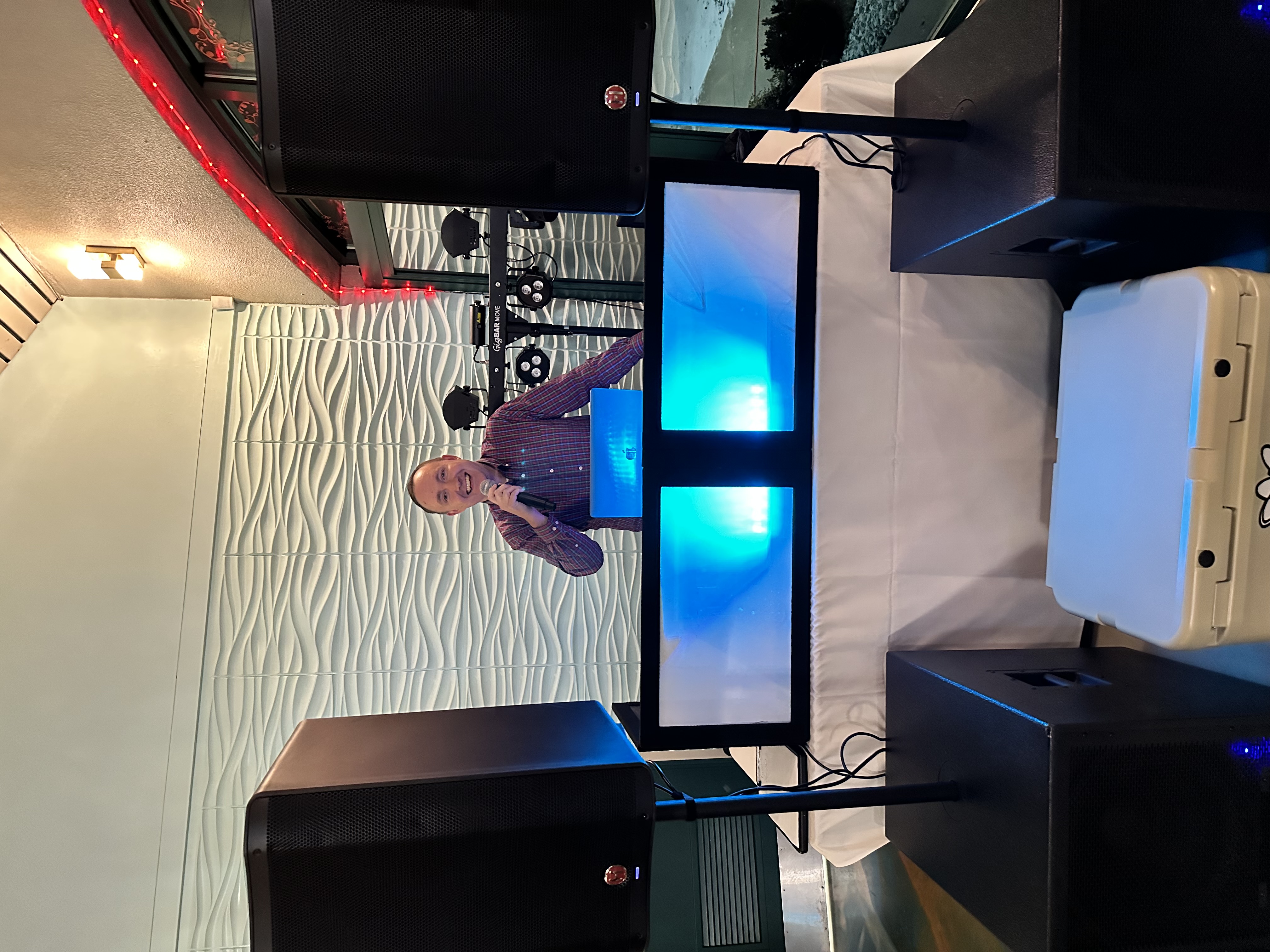
A DJ can either amplify a music-based team building session or flatten it into background noise. The difference is whether you hire a performer or a facilitator. For team building, you want the second one, someone who can teach a call-and-response, run a name-that-tune round, and hand the room back to you for a debrief.
Frame the booking as a team building engagement, not a dance party. Tell the provider up front that the goal is participation, not performance. A facilitator-style DJ will build in structured segments; a party-style DJ will default to a continuous set list.
Ask every provider these questions before you book:
- Can you run a 20-minute rhythm or clapping segment with non-musicians?
- How do you get reluctant participants into the activity without singling anyone out?
- Can you MC the debrief and hand the mic back to our team lead on cue?
- Do you take requests, and how do you screen lyrics for workplace-appropriate content?
- What is your backup plan if the sound system fails mid-session?
- Are you insured, and do you charge travel fees?
A common pattern is to book the DJ for the full event but reserve the first 30 minutes for structured team building and the rest for open music. That split gives you the cohesion payoff early, when attention is highest, and the celebration later, when people are ready to relax.
What to check | Why it matters for team building | Red flag |
|---|---|---|
Facilitation experience | Keeps activities on track, not just music playing | Only talks about playlists and lighting |
Structured segment design | Turns listening into participation | "I just read the room" |
Clean-lyric screening | Protects the company from HR issues | No screening process mentioned |
Backup gear | Saves the session if audio fails | No plan mentioned |
Insurance and travel policy | Protects the company and the budget | Vague on distance or coverage |
At TheMovement315, we have run corporate functions across Central New York for over two decades. Our pressure-free phone consultations let us build the playlist and the activity flow around your crowd, not a generic template. We also offer photo booths and karaoke as add-ons that give guests something to do between speeches.
Pricing depends on your date, guest count, and add-ons. Reach out for a quote rather than guessing at a number.
How to Run a Music Workshop for Remote Teams
Remote music workshops work when the tech stays simple and the activity fits a screen. You do not need perfect audio. You need a clear host and a format that survives lag.
A common approach is to run the session in two parts. First, a listening game where everyone types answers in chat. Then, a short creative task where small breakout rooms build something together.
Follow these steps:
- Send a one-page kit list a week ahead (phone, headphones, a shaker or cup).
- Open with a two-minute name-that-tune round in chat.
- Move into breakout rooms of four to build a themed playlist.
- Bring everyone back and let each room play one track.
- Close with a quick round of applause and a shared takeaway.
The lag problem is real. Avoid activities that need perfect timing across screens. Lean on guessing games, playlist building, and chat-based rounds instead.
Measuring the ROI of Music in Corporate Team Building
The ROI of music in corporate team building shows up in engagement, retention, and communication, not in a single spreadsheet cell. The mistake most teams make is treating the event as a one-off and never measuring anything.
Measure these:
- Turnover intent: ask how likely people are to stay, on a 1-5 scale, one week before and four weeks after.
- Cross-team contact: count new connections people report after the event, and check whether those contacts show up in later project threads.
- Event feedback: run a two-question survey right after, one on enjoyment, one on whether they would recommend the format.
- Participation rate: track how many people actually joined in versus watched, since participation is the leading indicator of cohesion.
- Repeat requests: see if teams ask for the format again, which is the clearest signal the activity earned its budget.
Here is the takeaway: music is not a nice-to-have. It is a fast, cheap way to build team spirit, improve communication, and give people a reason to show up.
Conclusion
Getting people to actually enjoy team building is the hard part. Music solves it. It gives every guest a role, a beat, and a shared win that sticks long after the event ends.
Frequently Asked Questions
What are some fun team building activities that use music?
Group drumming circles, playlist battles where teams defend song choices, song trivia, and collaborative songwriting all work well. For a 30-minute session, try a rhythm circle where each person adds a beat while maintaining eye contact. These activities build synchronization and active listening without requiring anyone to have musical training. The key is choosing something that lets everyone participate at their comfort level.
How can a professional DJ enhance corporate team building?
A skilled DJ reads the room and adjusts energy in real time, handles MC duties so organizers can participate, and ensures music fits the group's demographics. When hiring a DJ for corporate events, look for someone who offers a pre-event consultation, takes playlist requests seriously, and has experience with mixed-age groups. The right DJ keeps transitions smooth and prevents awkward silences that kill momentum.
How do you choose the right music for a diverse corporate group?
Build a playlist that spans decades and genres, then let the DJ read the crowd and shift accordingly. A good rule is to start with universally recognizable songs from the 80s and 90s, then move into current hits once energy builds. For music-based icebreakers for meetings, choose instrumental or low-lyric tracks so people can talk over them. Always ask about explicit content policies before the event.
What are the benefits of using music in corporate workshops?
Music improves collaboration by synchronizing group attention and reducing social barriers. Rhythmic alignment activities help teams practice non-verbal communication and cueing, skills that translate directly to workplace coordination. Group music-making also creates shared purpose and collective output, which strengthens team spirit. Even background music during brainstorming sessions can improve mood and creative synergy, making participants more willing to contribute ideas.