How to Keep Wedding Guests Dancing All Night
Table of Contents
- Build Your Wedding Reception Music Timeline First
- Best Wedding Dance Floor Songs That Actually Work
- How to Keep Wedding Guests Dancing: Crowd Reading and Flow
- Venue Acoustics, Lighting, and Dance Floor Atmosphere
- Late-Night Energy: Snacks, Hydration, and Interactive Elements
- How to Hire a Wedding DJ Who Keeps the Party Moving
- How to Keep Wedding Guests Dancing: What to Do Right Now
Last Updated: August 29, 2026
Build Your Wedding Reception Music Timeline First
Your wedding reception music timeline is the skeleton everything else hangs on. At TheMovement315, we've worked hundreds of receptions over more than two decades, and the single biggest mistake couples make is treating music as an afterthought rather than a structural element of the evening.
A reception typically flows through predictable phases: cocktail hour, dinner, formal events, open dancing, and a late-night push. Each phase has a different energy goal. The mistake most couples make is leaving too little time for open dancing. If dinner runs long and the cake cutting eats another 20 minutes, you might have 45 minutes of actual dance floor time. That is not enough. Build your timeline with dancing as a protected block, not whatever is left over.
When to Open the Dance Floor
Most couples find that opening the floor around 60 to 90 minutes into the reception, once dinner is winding down, produces the best results. Guests are fed, drinks have loosened things up, and the formal obligations are mostly behind everyone.
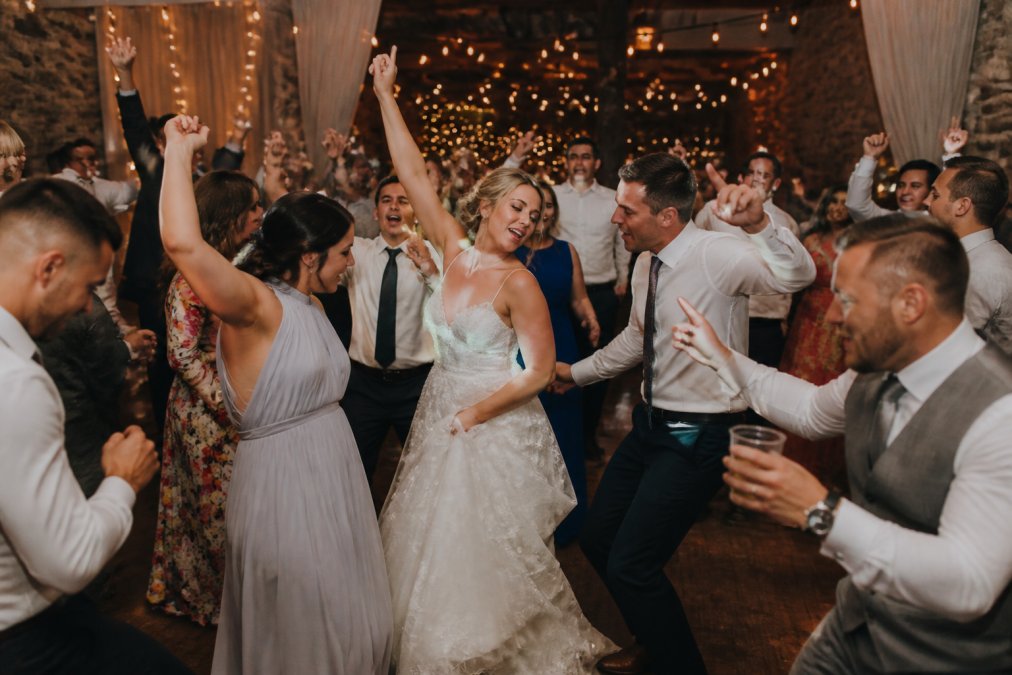
Waiting for cake cutting or bouquet tosses before opening the floor kills early momentum. Do not let the energy cool. A skilled DJ will channel the emotional high from the first dances directly into the first high-energy song of the night when the dance floor opens.
Pacing Energy Across the Night
Think of your reception energy as a wave, not a wall. You cannot sustain peak intensity for three hours. According to American Psychological Association research on social energy and group dynamics, sustained high stimulation without variation leads to fatigue rather than sustained engagement.
A practical pacing structure:
- Opening surge (first 20 minutes): High-energy crowd favorites to get bodies moving
- Settle-in period (next 30 minutes): Mix of tempos, crowd-pleasers, some slower songs
- Mid-night push (peak dancing block): Your biggest floor fillers, back to back
- Late-night energy (final hour): Second wind songs, high-BPM tracks, crowd sing-alongs
Best Wedding Dance Floor Songs That Actually Work
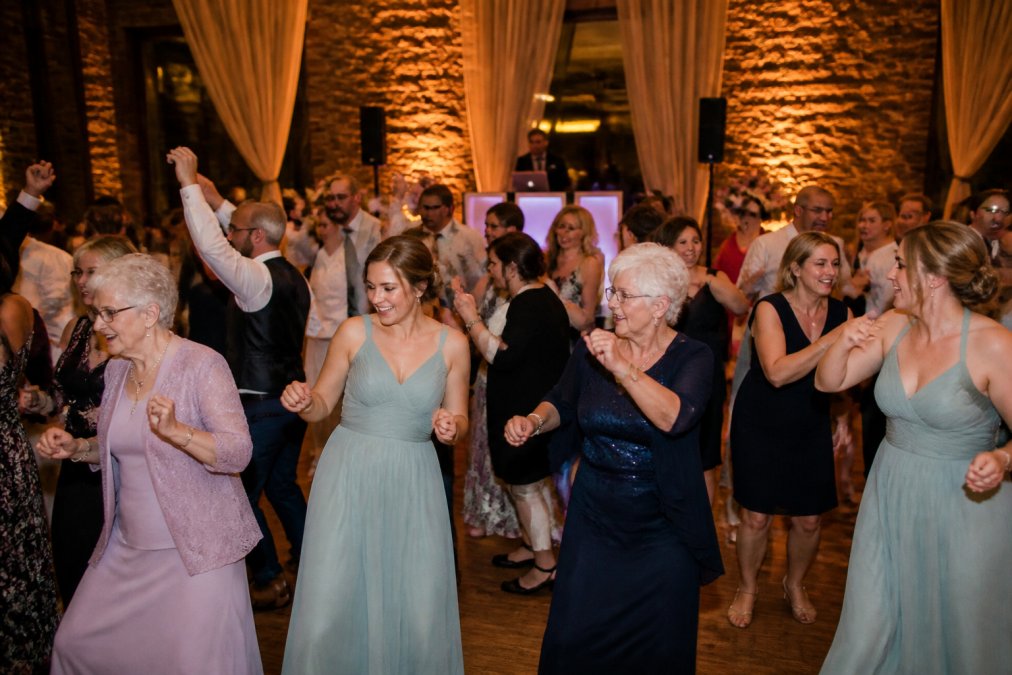
The most reliable dance floor fillers share a few common traits: a recognizable intro within the first four bars, a tempo between 120 and 130 BPM for high-energy moments, and broad cultural familiarity. Songs that transcend era, think classic Motown, late-90s pop, and certain disco tracks, tend to pull every age group toward the floor simultaneously.
Song selection is only half the equation. The other half is sequencing. A great song dropped at the wrong moment lands flat. A merely good song dropped when energy is already building can ignite a floor.
Balancing Generations Without Alienating Anyone
A multi-generational crowd is the defining challenge of wedding entertainment. The common approach of alternating songs for different age groups actually fragments the floor rather than unites it.
A better framework is to identify songs that cross generational lines organically. Classic rock anthems, certain soul and R&B tracks, and well-known pop songs from the early 2000s land across age groups. Build your peak dance block around these crossover tracks, then use the edges of the night to serve specific generations more directly.
Time Block | Primary Audience | Genre Focus | Energy Level |
|---|---|---|---|
Cocktail Hour | All ages | Jazz, soft pop, classic soul | Low |
Early Dancing (8-9 PM) | Older guests | Classic rock, Motown, 80s pop | Medium |
Peak Block (9-10:30 PM) | All ages | Crossover hits, 90s-2000s pop | High |
Late Night (10:30 PM+) | Younger guests | Current hits, hip-hop, EDM | Very High |
Cultural considerations matter too. If your guest list includes families from different cultural backgrounds, discuss specific songs or genres with your DJ in advance.
Floor-Clearing Songs to Avoid
Some traditions clear the dance floor faster than anything else. The garter toss and bouquet toss, when handled poorly, stop momentum cold. Many couples are quietly dropping these traditions.
Beyond traditions, certain song types reliably empty a floor: overly long instrumental intros, songs with strong generational divides and no crossover appeal, and back-to-back slow songs mid-reception. One slow song is a breather. Two in a row is an invitation to sit down and stay seated.
How to Keep Wedding Guests Dancing: Crowd Reading and Flow
Keeping wedding guests dancing is less about the playlist you build in advance and more about how well your DJ reads the room in real time. A static playlist, no matter how carefully curated, cannot account for the actual energy in the room at 9:47 PM on your specific night.
Crowd reading is the ability to identify which guests are on the floor, what is making them stay, and what is about to pull them off. An experienced DJ watches body language, monitors floor density, and adjusts tempo, genre, and energy accordingly. This is a skill that takes years to develop and cannot be replicated by a Spotify playlist.
The Psychology Behind the First Dance Transition
The first dance is the emotional centerpiece of the reception. The transition out of it is one of the most psychologically loaded moments of the night. Guests have just watched something intimate and personal. The challenge is converting that emotional warmth into physical energy on the dance floor.
The transition song matters enormously. A jarring shift to a high-BPM track immediately after the first dance can feel tone-deaf. A gradual build, starting with a mid-tempo crowd favorite and escalating over two or three songs, honors the emotional moment while redirecting energy toward the floor.
Managing Song Requests Without Losing Control
Song requests can derail the entire reception flow. The solution is not to ban requests, but to establish a clear system in advance.
A practical approach:
- Collect song requests on the RSVP card or through a pre-wedding form
- Review all requests with your DJ at least two weeks before the event
- Designate a "yes" list, a "maybe" list, and a firm "do not play" list
- Give your DJ authority to decline floor-clearing requests in the moment, even if they came from a well-meaning relative
According to The Knot's annual wedding planning research, song requests are one of the top sources of reception conflict between couples and their entertainment. Giving your DJ clear authority to manage requests protects both the dance floor energy and your relationship with your guests.
Venue Acoustics, Lighting, and Dance Floor Atmosphere
The physical environment shapes how guests experience music as much as the music itself. Poor acoustics, bad sound placement, or inadequate lighting can undermine even the best DJ and playlist.
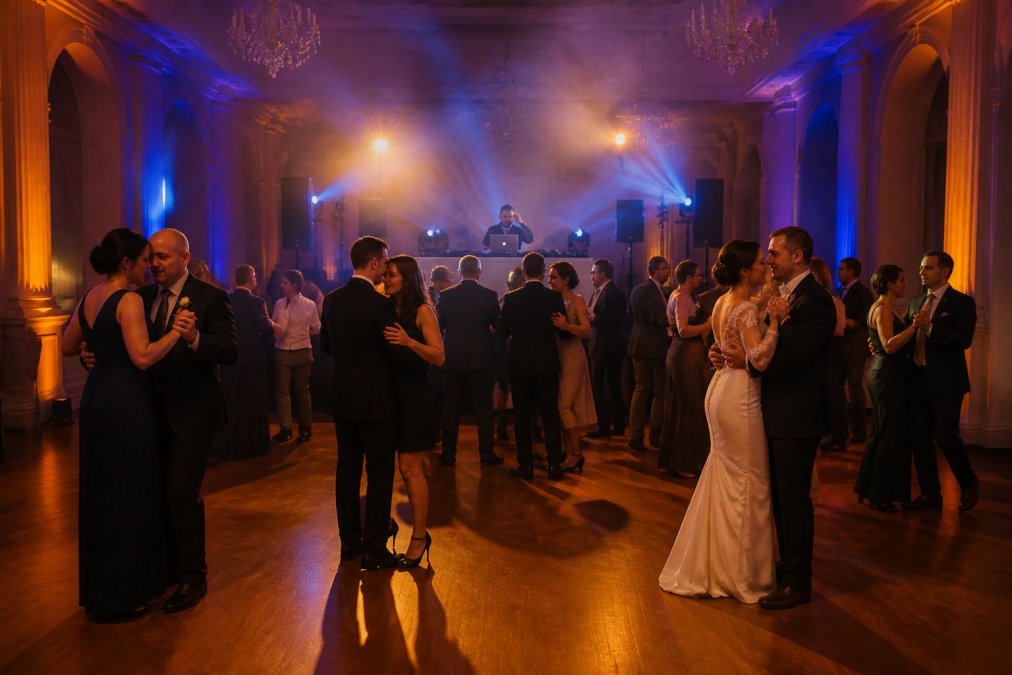
Venue acoustics are often overlooked. A room with hard floors, high ceilings, and no soft furnishings produces significant echo and sound diffusion. A professional sound system, properly positioned, compensates for these issues. A laptop and a Bluetooth speaker does not.
Key acoustic and atmosphere considerations:
- Speaker placement: Speakers should cover the dance floor evenly, not just aimed at the center
- Dance floor size: A floor that is too large feels empty and discourages dancing; a floor that is too small creates congestion
- Uplighting: Colored LED uplighting along the walls dramatically changes perceived energy; warm amber and deep blue tones create a party atmosphere
- Dance floor lighting: Moving lights and LED props signal to guests that this is a dancing space
Position the dance floor away from the bar and catering stations. When possible, position the DJ so they face the dance floor directly, creating a natural focal point.
Late-Night Energy: Snacks, Hydration, and Interactive Elements
The late-night hour, roughly the last 60 to 90 minutes of the reception, is where many weddings lose momentum. Guests are tired. Alcohol has peaked. Intentional planning pays off here.
Late-night snacks are a genuine energy management tool. A small snack station with simple, easy-to-eat food gives guests a reason to stay and a second wind of energy. Hydration matters just as much. A water station near the dance floor keeps energy levels higher through the final hour.
Interactive elements extend engagement beyond passive listening:
- LED props and glow sticks: Distributed during the late-night block, these create visual energy
- Karaoke segments: A brief karaoke interlude often pulls guests back who had retreated to their seats
- Crowd participation moments: A skilled master of ceremonies can generate energy through call-and-response and dance challenges
According to Wedding Wire's guest experience research, receptions that include interactive entertainment elements beyond dancing consistently receive higher satisfaction ratings from guests.
How to Hire a Wedding DJ Who Keeps the Party Moving
The difference between a wedding reception that people talk about for years and one they politely describe as "nice" usually comes down to the DJ. A great DJ is not just a person with a sound system and a Spotify account. They are an experienced crowd reader, a master of ceremonies, a timeline manager, and an energy architect.
Most couples book a DJ based on price and availability. The couples who end up with the best receptions book based on fit, experience, and a demonstrated ability to read a room.
Questions to Ask Before You Book
Before committing to any DJ, get clear answers to these questions:
- How do you handle song requests on the night? You want a DJ with a clear system, not one who promises to "play everything."
- Can you show me examples of receptions you've done for mixed-age crowds? Experience with multi-generational guests is a specific skill.
- What happens if you have a technical failure? A professional has backup equipment.
- Will you serve as MC, or is that a separate hire? MC duties and pacing are often bundled with DJ services but not always.
- How do you handle the first dance transition specifically? This question separates experienced wedding DJs from general event DJs.
- What is your process for the pre-event consultation? A DJ who does not ask detailed questions before the event will make assumptions on the night.
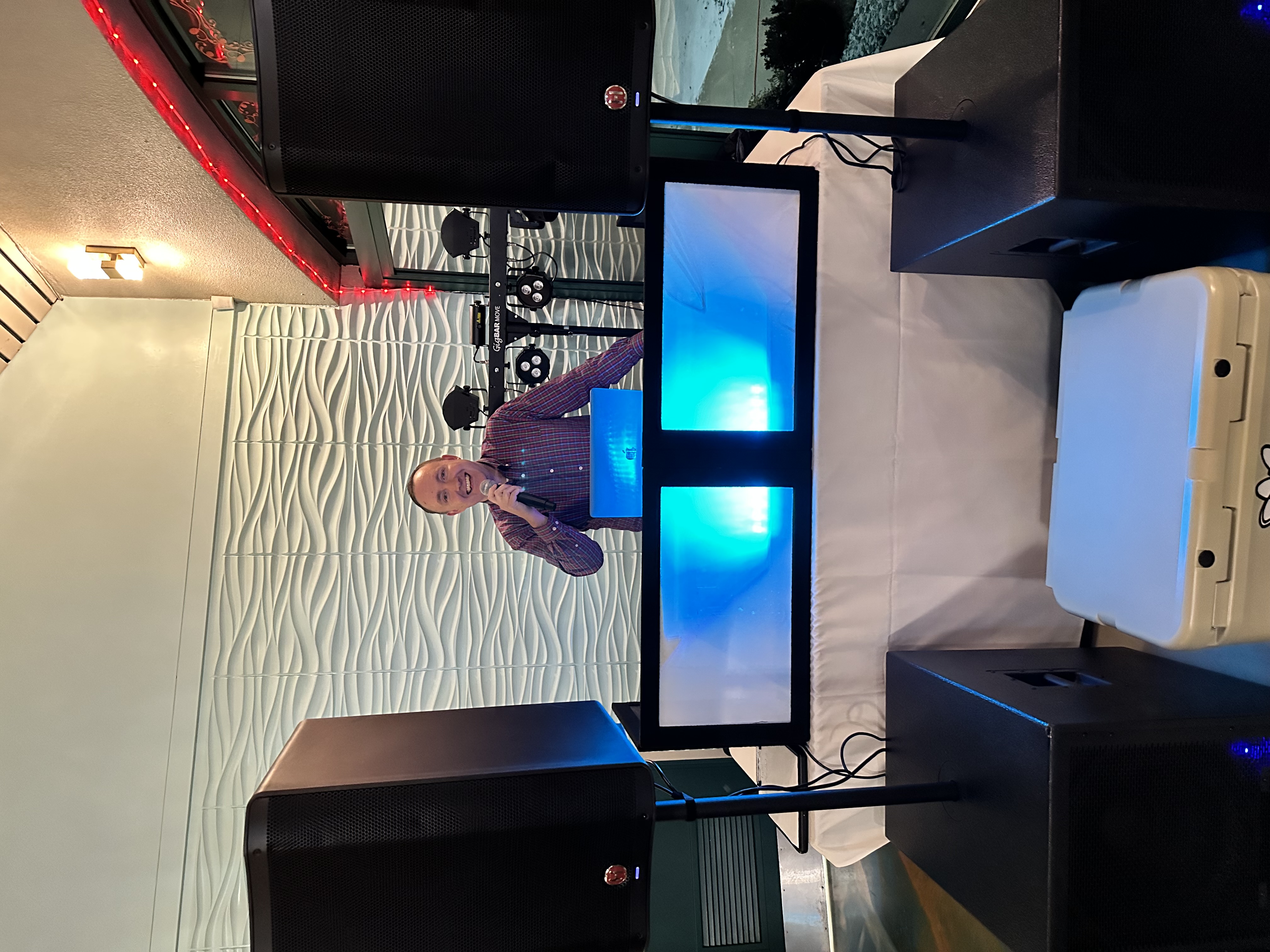
TheMovement315 offers pressure-free phone consultations specifically designed to answer these questions before you commit to anything. With over 20 years of experience across weddings, corporate events, and private celebrations, the consultation process is built around understanding exactly what you need.
How to Keep Wedding Guests Dancing: What to Do Right Now
Keeping wedding guests dancing all night is a solvable problem. It requires intentional planning, the right entertainment partner, and a willingness to protect the dance floor as a priority.
Here is your action checklist to start today:
- Block out your reception timeline with dancing as a protected, non-negotiable segment
- Identify your must-play songs, your do-not-play songs, and your "if the floor needs it" songs
- Research your venue's acoustics and ask specifically about speaker placement and lighting options
- Plan a late-night snack station and a water station near the dance floor
- Prepare a curated list of multi-generational crossover songs to share with your DJ
- Establish a song request policy and communicate it to your DJ before the event
- Ask every DJ candidate the six questions listed above before booking
The common thread across every successful reception we have worked is simple: the couples who had the best dance floors treated entertainment as a strategic priority, not a vendor checkbox. They thought about their guests' experience, planned for energy management across the full night, and hired professionals who could execute under pressure.
Planning a reception where the dance floor stays packed all night takes more than a good playlist. TheMovement315 brings over 20 years of experience in crowd reading, reception flow management, and multi-generational entertainment to every event. From customized DJ services and uplighting to interactive photo booths and karaoke, every detail is designed to keep your guests fully engaged from the first dance to the last song. Get a quote from TheMovement315 and build the reception your guests will still be talking about years from now.
Frequently Asked Questions
What time should dancing start at a wedding reception?
Most receptions open the dance floor after the first dance, parent dances, and the wedding party introduction — typically 45 to 90 minutes into the reception. Starting too early, before dinner ends, splits attention and thins the crowd. A good wedding DJ will read the room and signal the right moment to transition, usually right after the cake cutting or the first big group song, when energy and alcohol are both at a comfortable level.
How do you encourage shy guests to dance at a wedding?
Start with universally loved, familiar songs that lower the social barrier — think crowd sing-alongs or well-known hits from the couple's playlist. Interactive elements like LED props, a photo booth nearby, or a quick line dance break give hesitant guests a structured reason to join in. Seating arrangements also matter: placing outgoing guests near the dance floor creates a visual pull. A skilled MC can issue direct, fun invitations without making anyone feel singled out.
How do you keep both grandparents and college-age guests engaged on the dance floor?
The key is sequencing, not compromise. Rather than blending genres awkwardly, a good wedding DJ alternates blocks — a few current hits, then a Motown or classic rock set, then back again. This gives each group their moment without clearing the floor. Bride and groom input on must-play songs for both age groups, gathered well before the event, lets the DJ plan transitions that feel natural rather than jarring.
What is the 30-5 minute rule for weddings?
The 30-5 rule is a reception timing guideline: give each major reception segment roughly 30 minutes of breathing room, and use 5-minute musical transitions to signal the shift from one moment to the next — dinner to dancing, toasts to first dance, and so on. It prevents any single segment from dragging while giving guests enough time to settle in. A well-planned wedding reception music timeline uses this rhythm to maintain energy without making the night feel rushed.
This article was written using GrandRanker