How to Plan a High-Energy Corporate Awards Ceremony
Table of Contents
- Start With Event Objectives, Not a Theme
- Build Your Corporate Awards Ceremony Timeline
- Corporate Awards Ceremony Run of Show: Minute-by-Minute Pacing
- Your Awards Ceremony Program Template
- Corporate Awards Ceremony Ideas That Keep the Room Awake
- Venue, Budget, and Guest Logistics That Protect the Energy
- Contingency Planning and Measuring Engagement
- Conclusion: Recognition That People Actually Remember
- Frequently Asked Questions
Last Updated: October 12, 2026
Start With Event Objectives, Not a Theme
Most teams book a venue before they know what the night is supposed to do. The goal of a corporate awards ceremony is to make employees feel seen and send them home proud of where they work.
Before touring a space, write down what success looks like. Ask three questions:
- What do we want people talking about on Monday?
- Which achievements matter most this year?
- How do we want winners to feel when they walk up to the stage?
At TheMovement315, we bring over two decades of experience to high-energy events, and the best share one trait: the planner knew the point of the night before picking a color scheme.
Define What Success Looks Like Before You Book Anything
Skip vague goals like "a fun night." Set targets you can check afterward: attendance rate, number of award categories, and how many guests stay past the final award.
A short survey the next morning gives the clearest read. Ask one question: "Would you attend again?"
Build Your Corporate Awards Ceremony Timeline
An awards ceremony timeline is the backbone of the project. Work backward from the event date and you'll never scramble. Most mid-size ceremonies need about 12 weeks from kickoff to showtime.
According to the U.S. Small Business Administration's event planning guidance, starting logistics early is one of the biggest factors in keeping costs and stress under control. Here's how we'd break it down.
The 12-Week Countdown
- Weeks 12-10: Set objectives, budget, and guest count. Book the venue.
- Weeks 9-8: Choose award categories and build the guest list.
- Weeks 7-6: Send save-the-dates. Hire entertainment and AV.
The Final 72 Hours
The last three days are for locking details, not changing them. Confirm the AV setup, print the program, and rehearse with the emcee. Walk the stage. Test the microphone twice.
Corporate Awards Ceremony Run of Show: Minute-by-Minute Pacing
A corporate awards ceremony run of show is the written script for the entire event, timed to the minute. It tells everyone, from the emcee to the AV team, what happens and when.
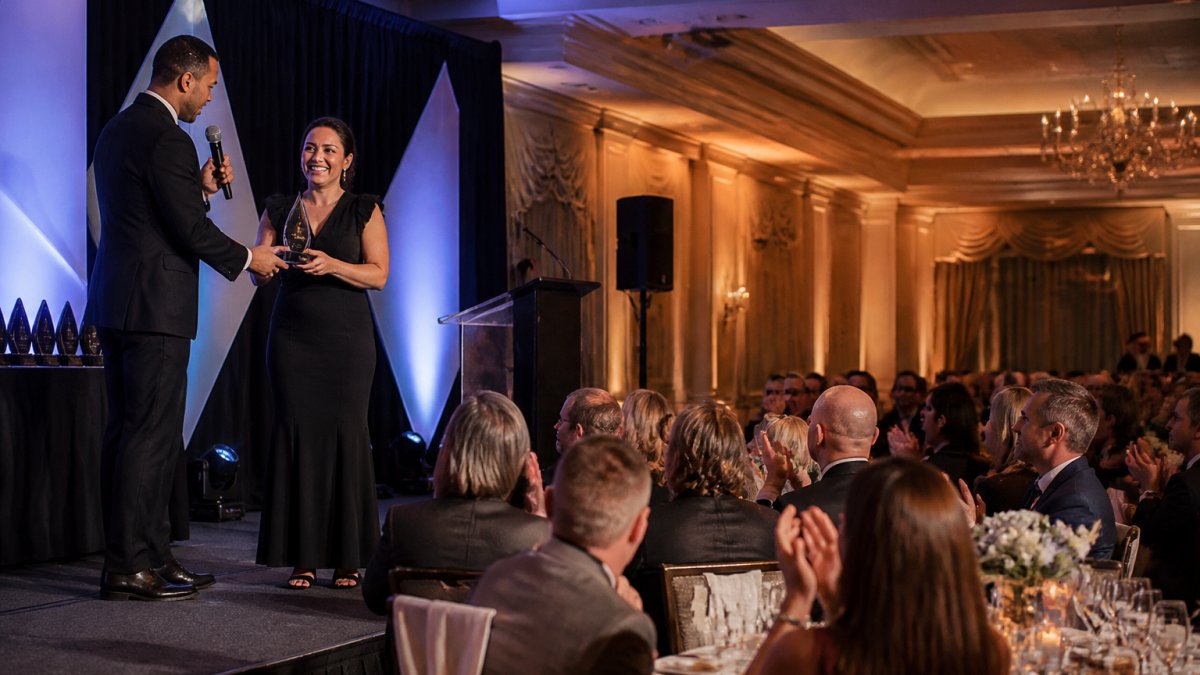
Pacing is where most ceremonies die. A tight, high-energy show keeps the room awake and the applause loud. Here's our format.
The Three Rules That Protect Pacing
- Cap every transition at 20 seconds. The walk from table to stage, the handshake, the photo, if it takes longer, attention drifts to phones. Mark transition time in the script like segment time.
- Never stack two slow moments back to back. A memorial tribute followed by a lifetime-achievement award is a dead zone. Insert a music sting, host joke, or short video between them.
- Reset the room every 15 minutes. An audience reset is any 60-90 second change of stimulus: a walk-up song change, a lighting shift, a host moving into the aisle, a short audience interaction. Without resets, applause fatigue sets in around the 40-minute mark.
Sample 90-Minute Run of Show (With Transition Times)
Time | Segment | Transition In | Reset Cue |
|---|---|---|---|
0:00-0:10 | Welcome and opening music | House lights down at 0:00 | High-energy track, host enters from back of room |
0:10-0:15 | Opening remarks | 15-sec walk to podium | Host moves into aisle for first award |
0:15-0:35 | Award Block 1 (3 categories) | 20-sec walk-up per winner | Music sting between categories |
0:35-0:40 | Reset: host interaction | 30-sec crowd prompt | Host asks room to applaud a department |
0:40-0:55 | Award Block 2 (3 categories) | 20-sec walk-up per winner | Lighting shift per category |
0:55-1:05 | Entertainment break | 10-sec AV crossfade | Full performance or DJ set |
1:05-1:25 | Final award block (2 categories + top honor) | 20-sec walk-up per winner | Build music under final category |
1:25-1:30 | Closing words and group photo | 15-sec stage reset | Photo flash cue, then house music up |
Keep acceptance speeches to 60 seconds. Hand winners a card with that limit at check-in. The first two winners usually run long and the rest follow, so brief the first winner specifically, and the night self-corrects.
How to Build the Script So Anyone Can Run It
Write the run of show in two columns: what the audience sees, and what the AV team does. The emcee reads the left; the AV lead reads the right. When the two are in one paragraph, cues get missed.
Mark three cue types in the script:
- Hard cues (music start, lights down), these cannot slip.
- Soft cues (host walk, presenter handoff), these can flex by 10-15 seconds.
- Buffer cues (the 10-minute cushion before the final block), these absorb any overrun earlier in the night.
Adapting the Run of Show to Different Formats
A 90-minute ballroom script does not translate to a 45-minute hybrid broadcast or a 30-person team lunch. Adjust the structure, not just the length:
- Under 50 guests, in person: Drop the entertainment break. Keep two award blocks and one reset. Winners can speak up to 90 seconds because the room is small enough to stay attentive.
- 50-150 guests, in person: Use the full 90-minute structure above. This is the format the sample table is built for.
- 150+ guests, in person: Add a co-host and video screens. Cut each award block to 15 minutes by pre-recording winner reactions and playing them as winners walk up.
Your Awards Ceremony Program Template
An awards ceremony program template lists the order of events, award categories, and presenter names, keeping the emcee, AV team, and stage manager on the same page.
Copy this structure and fill in your own details:
EVENT: [Company] Annual Awards DATE: [Date] | VENUE: [Venue] EMCEE: [Name]
- Welcome & Opening Music (10 min)
- Opening Remarks by [Name] (5 min)
- Award Block 1: [Category], [Category], [Category]
- Presenter: [Name] | Walk-up song: [Track]
- Entertainment Break (10 min)
- Award Block 2: [Category], [Category]
- Closing Words & Group Photo (5 min)
NOTES: Speeches capped at 60 seconds. AV cues marked in red. Give a printed copy to every vendor. Digital versions get lost when the Wi-Fi drops.
Corporate Awards Ceremony Ideas That Keep the Room Awake
The best corporate awards ceremony ideas all do one thing: match the energy to the moment. A slow, formal roll call works for 30 people. It kills a room of 300.
Here's how to keep energy up across formats.
Energy Management by Audience Size and Format
- Under 50 guests: Keep it intimate. Use a single host, minimal staging, and let winners speak a little longer.
- 50-150 guests: Add walk-up songs, spotlights, and a photo moment at the stage.
- 150+ guests: Use video screens, a co-host, and tight 60-second speech limits.
Music does more work than most planners expect. A custom walk-up song for each winner turns a routine handshake into a moment people remember. This is where a DJ who reads the room earns their keep.
Venue, Budget, and Guest Logistics That Protect the Energy
Venue selection decides how much energy your ceremony can hold. A room too big swallows the applause; one too small feels cramped and hot.
When you tour a space, check three things:
- Capacity: Aim for a room that fits your guest count comfortably, not tightly.
- Acoustics: Can the person in the back row hear the emcee without straining?
- Layout: Round tables near the stage keep guests engaged. Long rectangular rows push people apart.
For budget, split spend into four buckets: venue and catering, entertainment and AV, awards and decor, and a small contingency.
Guest management matters just as much. Send invitations early, track RSVPs in one shared sheet, and build seating around who knows whom.
Contingency Planning and Measuring Engagement
Every ceremony needs a backup plan. The microphone will cut out. A winner won't show. The slideshow will freeze. The difference between a hiccup and a disaster is whether the response was written down beforehand.
The Contingency Playbook
Prepare for the failures that actually happen, and assign one person to each:
- Microphone failure: Keep a spare wireless handheld and a wired backup at the AV table, both tested during rehearsal. The emcee's default move is to keep talking while walking toward the backup, silence is what kills the room, not the dead mic.
- Music or playback failure: Have a pre-loaded backup device with the walk-up songs and stings already queued. Do not rely on streaming, venue Wi-Fi is the most common single point of failure at corporate events.
- Presentation or slideshow freeze: Export every slide deck to PDF and load it on a second laptop that stays offline. A frozen deck on the primary machine becomes a 10-second switch, not a five-minute apology.
Measuring Whether the Night Actually Worked
Attendance alone tells you who showed up, not whether the ceremony landed. Track a few measures that map back to your objectives:
- Attendance rate: RSVPs versus actual check-ins. A gap larger than roughly one in ten usually points to a date, venue, or timing problem worth diagnosing.
- Stay-through rate: How many guests are still in the room at the final award. This is the single best proxy for pacing, if the room empties during the third block, the run of show needs work.
- Program timing accuracy: Planned end time versus actual end time. A ceremony that finishes within 10 minutes of the script is a well-run ceremony.
The U.S. Bureau of Labor Statistics data on employee recognition consistently links recognition to better retention, so the effort pays off beyond one night. But the measurement only matters if you compare this year's numbers to next year's, set the baseline now, and the second ceremony gets easier to defend to leadership.
Conclusion: Recognition That People Actually Remember
A high-energy corporate awards ceremony isn't about a bigger budget. It's about clear goals, a tight timeline, and pacing that never lets the room go flat.
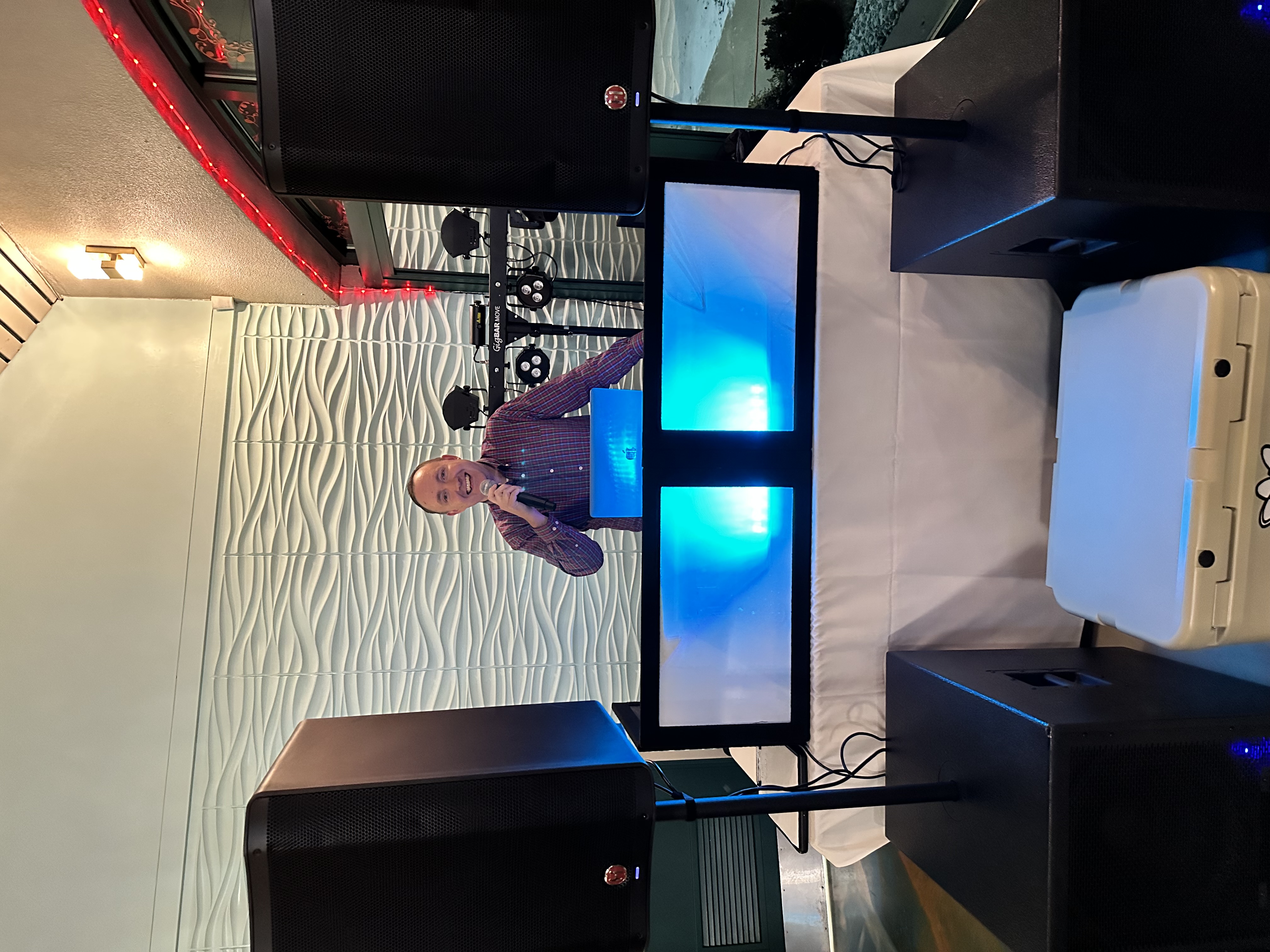
If you'd rather not manage the music, the MC duties, and the timing yourself, that's where we come in. TheMovement315 brings over 20 years of experience to corporate events across Central New York, with customized DJ services, photo booths that give guests keepsakes, and karaoke options that keep the celebration going.
Get a quote from TheMovement315 and give your people a night they'll talk about for months.
Frequently Asked Questions
How long should a corporate awards ceremony last?
Most corporate awards ceremonies run 90 minutes to two hours for the formal program, with a reception before or after. Past the two-hour mark, attention drops sharply and acceptance speeches start dragging. If you have more than 15 award categories, split the ceremony into two segments with a performance, dinner course, or entertainment break in between. A tight run of show with firm speech limits is the single biggest factor in keeping the room engaged from the first winner announcement to the last.
How do you keep guests engaged during an awards ceremony?
Vary the rhythm every 10 to 15 minutes. Alternate between award presentations, short entertainment, audience interaction, and food or drink moments. Use walk-up songs for each winner, keep acceptance speeches to 60 seconds, and have your emcee fill stage transitions with energy rather than silence. Music is your fastest tool here: a DJ reading the room can lift a flat moment instantly. For larger rooms, add a photo booth or karaoke station so guests stay active between segments instead of sitting through dead air.
What is a good run of show for an awards ceremony?
A solid run of show follows a clear arc: welcome and opening remarks (5-10 minutes), dinner or networking (20-30 minutes), award blocks grouped by category (30-40 minutes), an entertainment break (10-15 minutes), final awards and closing remarks (10 minutes), then open celebration. Group similar awards together so the pacing builds, place your most prestigious award last, and rehearse every stage transition. The corporate awards ceremony run of show should be written down to the minute and shared with your emcee, AV team, and DJ before event day.
What entertainment works well at a corporate awards ceremony?
Live music, a high-energy DJ, photo booths, and karaoke all work for corporate audiences when matched to the room. A DJ who also handles MC duties keeps the program moving without you managing it. Photo booths give guests something to do during downtime and create branded keepsakes. For mixed-age crowds, ask your entertainment provider to read the room and shift between eras and genres rather than locking into one playlist. Book entertainment that has handled corporate events before, and confirm in writing that they can cover announcements, walk-up songs, and transitions.