Wedding DJ Playlist Tips 2026: Your Complete Guide
Table of Contents
- Building a Wedding Reception Music Timeline That Works
- How to Keep Wedding Guests Dancing All Night
- Wedding DJ Do-Not-Play List Examples and How to Build Yours
- Must-Play Wedding Song List Template for 2026
- Wedding DJ Playlist Tips 2026: Trends, Transitions, and Technology
- Conclusion
- Frequently Asked Questions
Last Updated: September 24, 2026
Building a Wedding Reception Music Timeline That Works
A wedding DJ playlist succeeds or fails on timing, not just song choice. The strongest reception playlist in the world falls flat if it's played at the wrong moment. At TheMovement315, we've spent more than two decades building wedding reception music timelines across Utica, Syracuse, and Central New York, and the pattern is always the same: energy rises and falls in predictable waves.
Ceremony and Cocktail Hour: Setting the Tone
Ceremony music is the one part of the day where the playlist should be almost invisible. Couples typically choose two or three acoustic or instrumental pieces for the processional, one for the recessional, and then hand the rest to a curated setlist for the cocktail hour.
Dinner and Toasts: Background Without Distraction
Dinner music should sit underneath conversation, never on top of it. Think Motown, soft classic rock, or low-key R&B, all kept at a volume where grandparents at the far table can hear each other.
Open-Dance and Peak Hours: Where the Energy Lives
The open-dance moment is the payoff. This block usually runs 90 minutes to two hours, and it follows a deliberate arc: a warm-up stretch of crowd-proven floor fillers, a peak of high-tempo bangers, then a gradual cool-down. A professional DJ reads the room in real time and adjusts, rather than rigidly following a printed list.
Phase | Typical Duration | Music Priority | Energy Level |
|---|---|---|---|
Ceremony | 30-45 min | Instrumental, acoustic | Low |
Cocktail hour | 60 min | Jazz, soul, acoustic covers | Low-medium |
Dinner and toasts | 60-90 min | Motown, soft classics | Low |
Open dance | 90-120 min | Floor fillers, peak bangers | High |
How to Keep Wedding Guests Dancing All Night
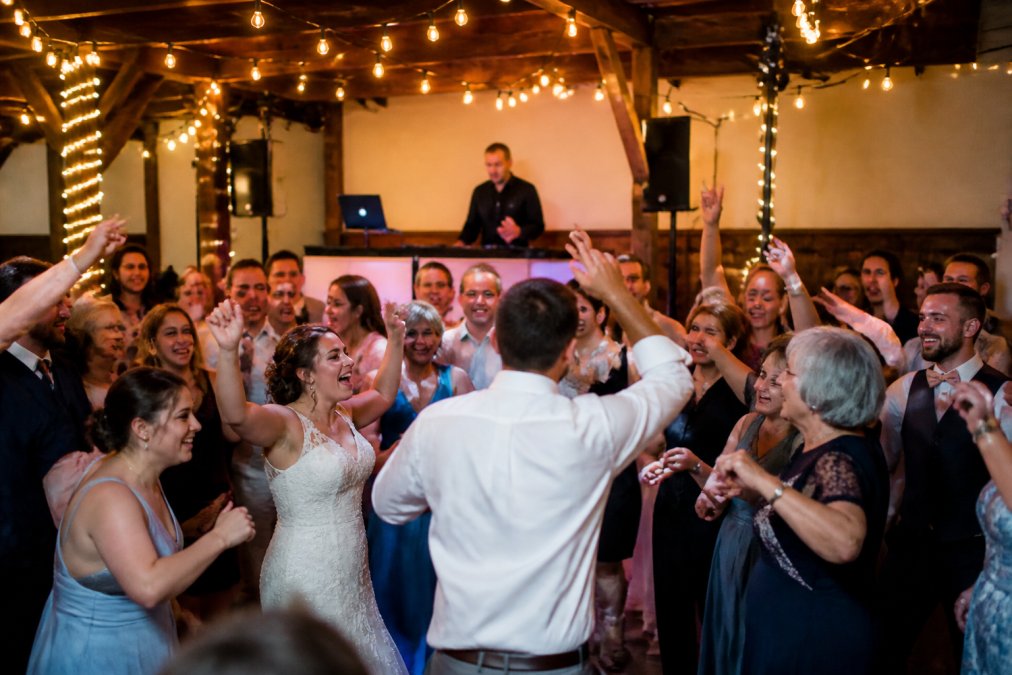
The secret to a full dance floor is variety within a recognizable groove. Guests dance when they know the song, and they stay when the next one feels connected to the last. That's transition flow, and it matters more than any single track.
Reading the Room and Adjusting in Real Time
Good DJs watch feet, not faces. If the floor thins during a song, the next selection shifts tempo or genre. If a track packs the floor, the DJ extends that energy with a tempo-matched follow-up.
Wedding DJ Do-Not-Play List Examples and How to Build Yours
A do-not-play list is a short, specific set of songs or artists you never want to hear at your reception. It's the single most effective tool for protecting your taste, and it takes ten minutes to write. The mistake most couples make is writing it too broadly, "no rap" or "nothing cheesy" gives a DJ nothing to work with, and a vague ban usually gets quietly ignored because it can't be enforced.
Build yours in three layers:
- Hard bans: specific songs tied to an ex, a funeral, or a memory you don't want on the dance floor. Name the exact title and artist, "no 'Perfect' by Ed Sheeran" is enforceable; "no sad songs" is not.
- Artist bans: whole acts you'd rather not hear, especially anything with explicit lyrics. If you want a clean-lyrics-only reception, say so explicitly rather than assuming the DJ will censor on the fly.
- Vibe bans: categories like "no line dances," "no slow songs after 10 p.m.," or "no group dances that pull people off the floor." These are the bans that most change the feel of the night.
Real Do-Not-Play Examples
Wedding DJ do-not-play list examples range from the obvious to the deeply personal. Common entries include:
- The chicken dance, the macarena, and the cha-cha slide, the trio most couples either love or ban outright. Pick a side; don't leave it to chance.
- "Every Breath You Take" by The Police, widely requested, widely regretted once guests realize what the lyrics actually say.
- "My Heart Will Go On" by Celine Dion, a funeral-adjacent association for many families.
- Any song from a previous relationship, the most personal ban on the list, and the one worth flagging privately to your DJ.
- Explicit-lyric tracks, if you're inviting kids or grandparents, a blanket clean-version rule is easier to enforce than a song-by-song list.
How a DJ Actually Enforces a Ban
Keep the total list to roughly 10-20 entries. A list of 60 bans leaves the DJ almost no room to read the room, and the night starts to feel like a checklist instead of a party.
Must-Play Wedding Song List Template for 2026
A must-play list is your guarantee that specific moments get specific songs. Keep it to 15-25 entries so the DJ still has room to read the room.
How to Fill In Each Category
Category | What to Include | Example Slot |
|---|---|---|
Ceremony | Processional, recessional | "Here Comes the Sun" |
First dance | One song, full version | Your chosen track |
Parent dances | One per parent | Sentimental pick |
Must-play dance | 10-15 crowd-proven songs | Floor fillers |
Last song | One closer | Meaningful send-off |
Fill the must-play dance slot with songs you've personally seen work at other weddings. Crowd-proven beats trendy every time.
Wedding DJ Playlist Tips 2026: Trends, Transitions, and Technology
This is where 2026 weddings differ from five years ago. Couples now arrive with a curated setlist built in a streaming app, and the best DJs treat that as a starting point, not a script. Three shifts matter most: how transitions actually work, how AI fits into planning, and how licensing shapes what a DJ can legally play.
The Psychology of Dance Floor Transitions
Most guides list songs. Almost none explain the mixing logic that keeps a mixed-age floor moving. The core principle is tempo continuity with genre surprise: keep the beats-per-minute (BPM) within roughly 5-10 of the previous track, but change the genre or era so a new group of guests recognizes the next song and steps onto the floor.
- Warm-up (95-105 BPM): Motown and '70s soul, pulls in parents and grandparents early.
- Bridge (105-115 BPM): '90s hip-hop and pop, the crossover zone where multiple generations overlap.
- Peak (115-128 BPM): Current top-40 and EDM, the younger crowd's moment, held for 20-30 minutes max.
- Reset (100-110 BPM): A singalong classic, brings the older guests back before the next peak.
AI-Assisted Playlist Planning
AI tools can now suggest tempo-matched transitions, flag songs that clash in musical key, and generate a base list from a prompt like "2026 wedding, mixed ages, no explicit lyrics." Use them to draft, not to decide. The algorithm doesn't know that your uncle requests the same song every family event, or that the floor empties the moment a certain genre starts.
Licensing: What Your DJ Can Legally Play
One area most couples overlook entirely is licensing. Under U.S. Copyright Office guidance on music licensing, a wedding DJ is generally responsible for using properly licensed music, which is why professional DJs subscribe to commercial services rather than playing personal streaming accounts over a venue's sound system. A personal Spotify or Apple Music account is licensed for personal listening, not for public performance at a reception.
Conclusion
Building a reception playlist that actually works takes more than a list of songs. It takes someone who can read a room, match tempos, and keep a mixed-age crowd on the floor from the first dance to the last.
Frequently Asked Questions
What are some popular wedding DJ playlists for 2026?
Popular 2026 wedding DJ playlists blend cross-generational floor fillers with current hits. Expect a mix of disco classics, 2000s hip-hop, Afrobeats, and pop remixes that appeal to both younger and older guests. Many couples build their playlist around a wedding reception music timeline that sequences cocktail hour acoustic sets, dinner background music, and peak-hour dance tracks. A must-play wedding song list template helps organize selections by moment, ensuring no genre dominates and every age group gets a turn on the dance floor.
How do I build a wedding DJ do-not-play list without offending my DJ?
A do-not-play list is a standard part of professional DJ collaboration, not an insult. Be specific: list exact songs, artists, or genres you want excluded (for example, no line dances, no heavy metal, no explicit lyrics). Share the list during your planning consultation and explain the reasoning briefly. Professional DJs appreciate clear boundaries because it prevents awkward moments. Pair your do-not-play list with a must-play list so your DJ understands the full picture of your musical taste and can fill gaps confidently.
How far in advance should I finalize my wedding reception playlist?
Finalize your must-play and do-not-play lists about four to six weeks before the wedding. This gives your DJ enough time to review requests, source any uncommon tracks, and plan transitions. You can make small adjustments up to one week before, but avoid major changes after that point. If you are using a wedding reception music timeline, confirm the sequence of key moments (first dance, parent dances, cake cutting) at least two weeks out so your DJ can coordinate with your planner or venue.
What is the 50/20/30 rule for wedding music planning?
The 50/20/30 rule suggests dividing your playlist into three buckets: 50% crowd-pleasing hits that reliably fill the dance floor, 20% songs that reflect your personal taste as a couple, and 30% requests or flexible picks your DJ can adjust based on the room's energy. This balance keeps the party accessible to all ages while still feeling personal. Share this framework with your DJ during planning so they understand which songs are non-negotiable and which are open to real-time swaps based on how guests respond.
How much control should I give my DJ over the playlist?
Give your DJ control over sequencing, transitions, and real-time adjustments, but keep final say on must-play and do-not-play lists. A skilled DJ reads crowd energy and knows when to shift from Motown to hip-hop or when to pull guests back to the floor after a slow song. Provide a curated setlist with clear boundaries, then trust your DJ to fill gaps and adapt. This partnership works best when you communicate your vibe (high-energy, relaxed, nostalgic) and let the professional handle the execution.
How do I balance my personal music taste with crowd-pleasing hits?
Use the 50/20/30 framework: 50% proven floor fillers, 20% personal favorites, and 30% flexible requests. During peak dance hours, prioritize high-energy tracks with cross-generational appeal. Save niche or sentimental songs for cocktail hour, dinner, or late-night sets when the crowd is smaller. If you love a genre your guests might not know, ask your DJ to pair it with a recognizable track using tempo matching or genre blending so the transition feels natural rather than jarring.
Should I provide a do-not-play list to my wedding DJ?
Yes. A do-not-play list prevents songs that remind you of an ex, feature explicit lyrics inappropriate for family members, or fall into genres you actively dislike. Common examples include the Cha Cha Slide, "Blurred Lines," or any song tied to a negative memory. Be specific about whether the ban applies to a single song, an entire artist, or a genre. Give this list to your DJ at least four weeks before the wedding so they can prepare alternatives that keep the dance floor energy high without crossing your boundaries.