What to Look for in DJs: A 2026 Hiring Guide
Table of Contents
- What to Look for in DJs: Experience and Professional Background
- The Importance of DJ Personality and MC Skills
- Equipment, Sound Quality, and Technical Setup
- Music Customization, Playlist Curation, and Genre Flexibility
- Questions to Ask a Wedding DJ Before You Book
- Average Cost of an Event DJ and What Affects Pricing
- DJ vs. Band: Choosing the Right Entertainment Format
- What to Look for in DJs After the Event: Post-Event Evaluation
- Frequently Asked Questions
Last Updated: August 30, 2026
What to Look for in DJs: Experience and Professional Background
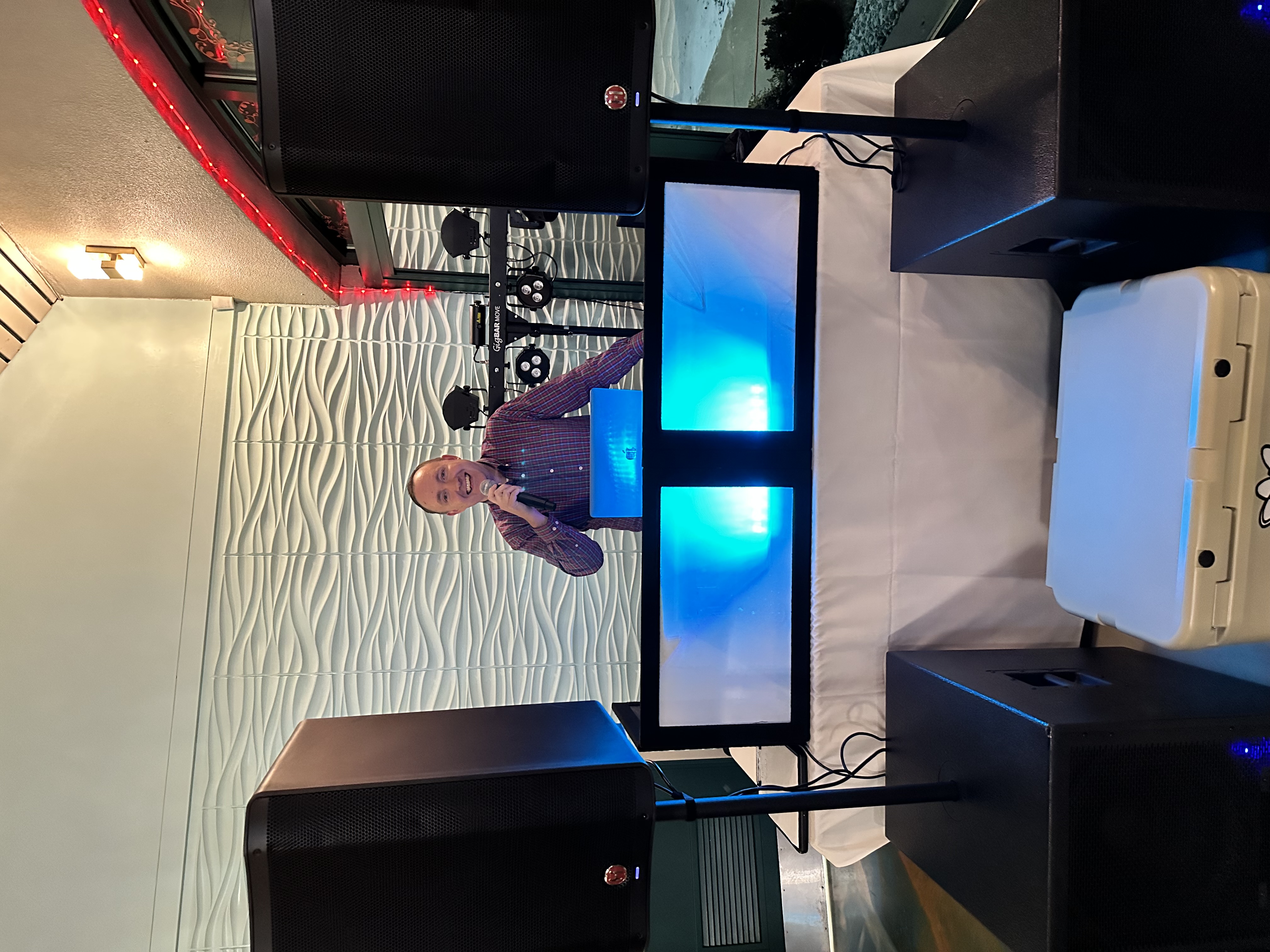
Knowing what to look for in DJs separates a forgettable event from one guests talk about for years. At TheMovement315, we've spent over two decades performing at weddings, corporate events, school dances, and private celebrations. Professional background matters most, not just years on the clock, but the quality and variety of those years.
A DJ who has only worked club nights may struggle at a wedding reception where energy shifts from cocktail hour to first dance to late-night dancing. Event DJs and venue DJs operate in completely different environments, and skills that fill a nightclub don't automatically translate to reading a mixed-age crowd at a reception hall.
How Many Years Is Enough?
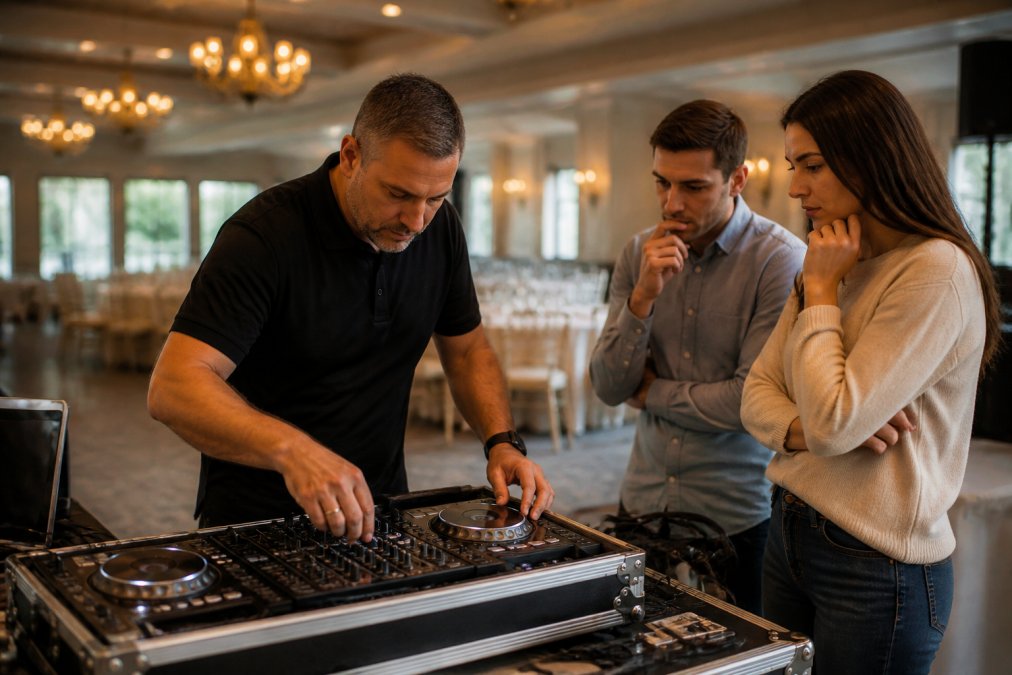
Five or more years of active event experience is a reasonable threshold for a wedding or large corporate event. However, years alone don't tell the whole story. A DJ with three years of heavy booking who has performed at 150+ events will likely outperform someone with eight years of occasional weekend gigs. Ask specifically: How many events per year? What types? What's the largest crowd they've managed?
Verifying References and Past Work
Always ask for video footage or testimonials from past events. A professional DJ should have no hesitation sharing these. Watch for energy, microphone presence, and how they handle transitions.
The Importance of DJ Personality and MC Skills
The biggest mistake couples and event planners make is treating the DJ role as purely musical. A great event DJ is also a master of ceremonies, and those two functions are inseparable at a wedding or large corporate gathering.
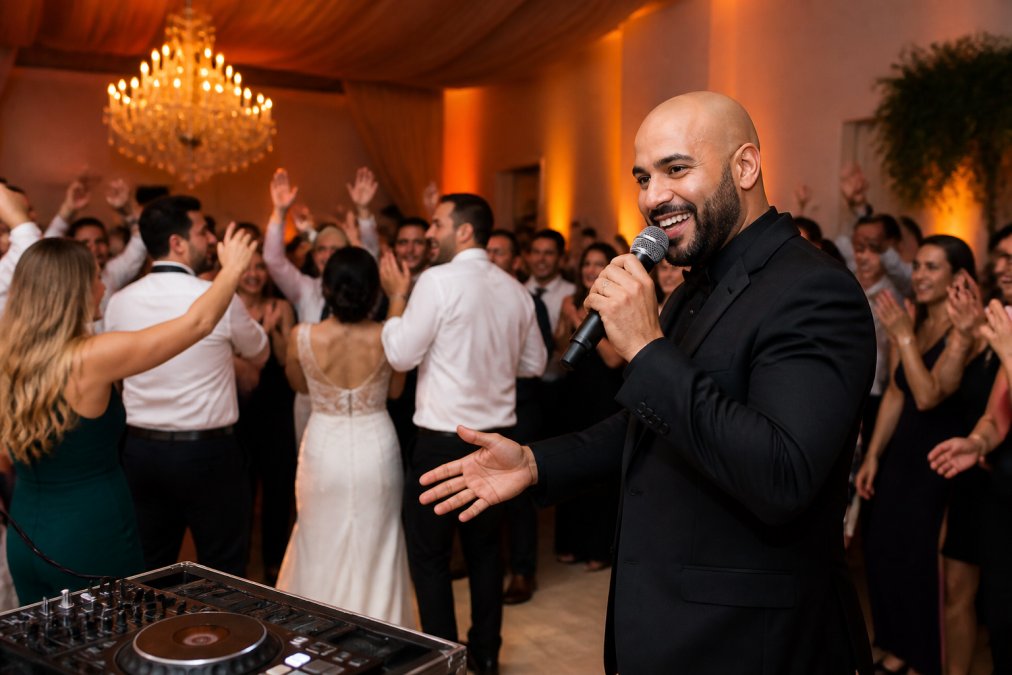
DJ personality and MC skills determine whether your event flows naturally or feels disjointed. A DJ who can command a microphone, introduce the wedding party with genuine energy, and keep guests informed without being overbearing is worth significantly more than one who simply plays good music.
Reading the Crowd and Managing Energy
Crowd engagement is a skill that develops over years of live performance. It means recognizing when energy is dropping and adjusting tempo before guests drift off the dance floor. It means knowing that the grandparents' table needs a familiar song to feel included, without alienating younger guests.
The real difference between an average DJ and an exceptional one is this: reactive DJs wait for the dance floor to empty before changing course. Proactive DJs prevent it from happening in the first place. Ask any candidate how they handle a crowd that isn't responding to their set.
Equipment, Sound Quality, and Technical Setup
Sound quality is the most underrated factor in the hiring process. Poor audio quality ruins an event regardless of how good the playlist is.
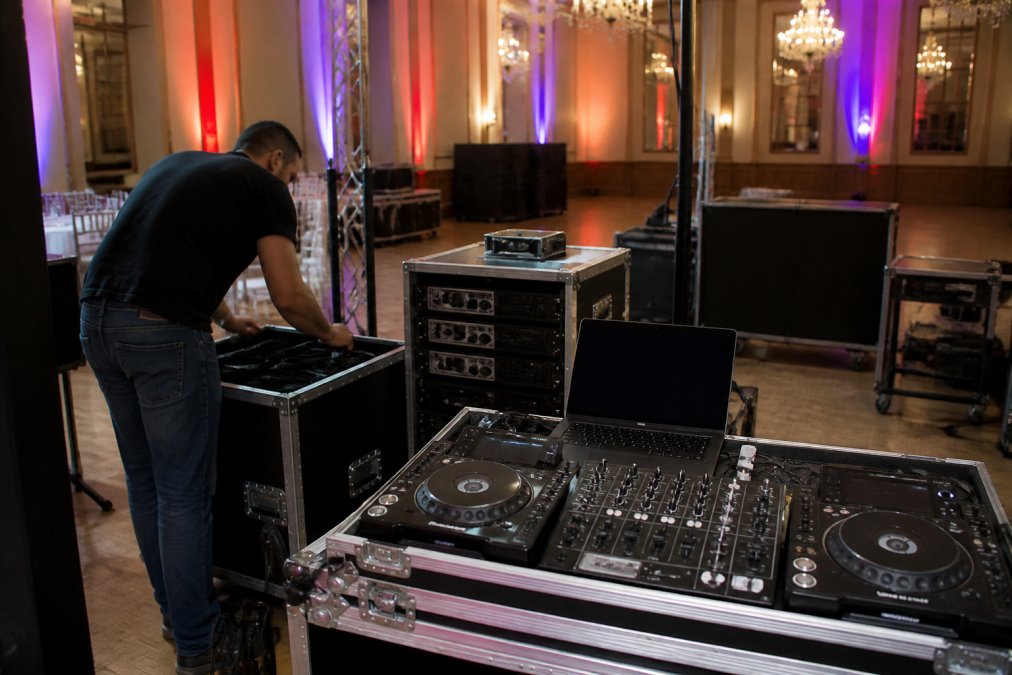
A professional-grade sound system should be sized appropriately for the venue. A system that works perfectly in a 100-person room will sound thin and strained in a 300-person ballroom. Ask the DJ specifically what equipment they use and whether they conduct a site visit or technical consultation before the event.
According to the Audio Engineering Society's guidelines on live event sound, proper speaker placement and power-to-room-size ratios are critical for consistent audio quality across all seating areas.
Backup Equipment and Venue Requirements
Every professional DJ should carry backup equipment: a second laptop loaded with the same music library, a spare mixer, extra cables, and a contingency plan for power failure. Ask directly: "What happens if your primary system fails mid-event?" If they don't have a clear answer, keep looking.
Venue requirements add another layer of complexity. Some venues have noise ordinances, power limitations, or load-in restrictions that require advance coordination. A DJ who has worked a variety of venues will already know how to navigate these.
Factor | What to Ask | Why It Matters |
|---|---|---|
Sound system size | Can it cover your venue's square footage? | Prevents thin or distorted audio |
Backup equipment | What redundancy do they carry? | Protects against mid-event failure |
Venue coordination | Have they worked your venue before? | Reduces day-of surprises |
Lighting setup | Is it included or a separate add-on? | Affects atmosphere and package cost |
Site visit or consultation | Do they assess the space in advance? | Ensures proper technical setup |
Music Customization, Playlist Curation, and Genre Flexibility
A DJ who defaults to a generic playlist without incorporating your specific requests isn't providing a customized service; they're providing a commodity.
Music library depth matters. A professional event DJ should have access to tens of thousands of tracks across multiple genres and decades. Genre flexibility is especially important for mixed-age events where you need to serve grandparents, middle-aged guests, and twenty-somethings without the evening feeling like a genre war.
The consultation process should cover your must-play list, your do-not-play list, and the overall mood arc you want for the event. Any DJ who dismisses the do-not-play list or treats your preferences as suggestions rather than requirements is not the right fit.
Playlist curation for a wedding reception typically involves distinct phases: cocktail hour, dinner service, first dances, and open dancing. Each phase requires different energy and music style.
Questions to Ask a Wedding DJ Before You Book
Knowing what to look for in DJs becomes much easier when you arrive at a consultation with the right questions.
- How many weddings have you performed this year? High volume suggests reliability and current experience.
- Can we provide a detailed must-play and do-not-play list? The answer should be an unqualified yes.
How do you handle song requests from guests during the event? Look for a clear policy that balances guest interaction with your preferences.
- What is your setup and breakdown timeline? This affects venue scheduling and vendor coordination.
- Will you personally be at our event, or could it be a substitute? Confirm who you're actually hiring.
- How do you coordinate with other vendors, like the photographer and caterer? Event coordination prevents timeline collisions.
- What happens if you have an emergency on our event day? Every professional has a contingency plan.
As documented in The Knot's wedding vendor hiring guide, couples who conduct in-person or video consultations before booking report significantly higher satisfaction with their entertainment choices.
Contract Requirements and Red Flags to Watch For
A professional DJ always works from a written contract. It should specify: the exact date, start and end time, venue address, services included, payment schedule, cancellation policy, and the name of the specific DJ performing.
Red flags in DJ contracts include:
- No cancellation clause. You have no protection if either party cancels.
- Vague service descriptions. "DJ services for your event" tells you nothing.
- No substitute DJ clause. You should have the right to approve any substitute or receive a refund.
Payment in full upfront. A reasonable deposit is standard; full payment before the event is not.
Average Cost of an Event DJ and What Affects Pricing
Pricing for professional event DJs varies based on experience level, event type, duration, geographic market, and package inclusions. You're paying for technical expertise, equipment investment, preparation time, and professional liability coverage.
Factors that typically affect DJ pricing include event duration, travel distance, day of the week, season, equipment requirements for venue size, and add-on services like lighting, photo booths, or karaoke.
The best approach is to request itemized quotes so you understand exactly what's included. TheMovement315 offers a pressure-free phone consultation where pricing is discussed in the context of your specific event needs.
DJ vs. Band: Choosing the Right Entertainment Format
The DJ vs. band decision comes down to four practical considerations: venue size, budget, music range, and event type.
Choose a DJ when:
- Your event spans multiple genres or decades
- The venue has acoustic limitations or noise ordinances
- You need precise control over specific songs, including first dance tracks
- Your event requires an MC function integrated with the music
Choose a live band when:
- The performance itself is the centerpiece of the event
- Your guest list skews toward a single musical era or genre
- Your venue has excellent acoustics and no volume restrictions
- The visual spectacle of live musicians fits your event aesthetic
A common misconception is that bands create more energy than DJs. The energy level depends far more on the performer's skill and crowd engagement than on the format. For mixed-age events, weddings with specific song requirements, or corporate events where entertainment needs to flex around a program, a professional DJ typically offers more versatility.
What to Look for in DJs After the Event: Post-Event Evaluation
Building a simple post-event review process helps you make better decisions for future events and gives you useful feedback to share with other planners.
Evaluate your DJ across these dimensions:
- Playlist adherence: Did they play your must-plays and honor your do-not-play list?
- Timeline management: Did they keep the event on schedule?
- Crowd engagement: Was the dance floor consistently active during open dancing?
- MC performance: Were announcements clear, well-timed, and appropriately energetic?
- Technical execution: Were there any audio issues or equipment problems?
- Vendor coordination: Did they communicate effectively with your photographer, caterer, and venue coordinator?
A structured post-event evaluation builds institutional knowledge, especially for corporate event planners and school administrators who book entertainment annually. Document what worked, what didn't, and whether you'd rebook.
According to the National Association for Campus Activities' event planning resources, post-event assessment is a standard practice for professional event coordinators and directly improves the quality of future bookings.
Finding the right DJ requires more than scanning a price list. The experience, technical setup, MC skills, and willingness to customize around your vision are what separate a professional from someone who just shows up with a laptop. TheMovement315 brings over 20 years of event experience, a genuine consultation process, and add-on services like interactive photo booths and karaoke that give your guests something to remember long after the last song. Get in touch for a no-pressure quote tailored to your event.
Frequently Asked Questions
How can you tell if a DJ is good?
Watch video footage of their actual performances, not just highlight reels. A skilled DJ maintains consistent energy, transitions smoothly between songs, and reads the crowd rather than sticking rigidly to a preset list. Ask for client references from events similar to yours. Pay attention to how they communicate during the consultation: a professional asks detailed questions about your preferences, your guest mix, and your event timeline before ever talking about their own equipment or style.
What are the most important questions to ask a potential wedding DJ?
Start with these: How do you handle song requests the couple hasn't pre-approved? What happens if your equipment fails mid-event? Do you carry liability insurance? Will you personally perform, or could a substitute show up? How do you manage the transition between cocktail hour and the reception? What does your MC role include? A DJ who answers these questions clearly and without hesitation has handled them before — that confidence is itself a green flag worth noting.
Is there a standard hourly rate for professional event DJs?
There is no single standard rate. Pricing for event DJs varies based on event type, duration, travel distance, equipment requirements, and whether MC services or extras like lighting and photo booths are included. A four-hour wedding reception will cost more than a two-hour birthday party. Rather than anchoring to an hourly figure, ask each DJ for a full package quote that itemizes what is included. That makes comparing proposals straightforward and prevents surprise add-on charges later.
What role does a DJ play in managing event flow and announcements?
A DJ who doubles as MC handles far more than music. They coordinate with your venue and catering staff to time key moments — grand entrance, first dance, cake cutting, toasts — and keep guests informed without over-talking the microphone. For corporate events, that means managing program segments and keeping the evening on schedule. For weddings, it means guiding the reception flow so the couple never has to chase down a coordinator. This dual role is one of the most underrated qualities to evaluate before booking.
This article was written using GrandRanker