Best Interactive Entertainment for Corporate Retreats
Last Updated: November 2, 2026
Quick Summary
The best interactive entertainment for corporate retreats pairs the format to your group size and goal: live trivia or game shows for 20-200 guests, music bingo for rooms up to 300, and cooking challenges or escape rooms for smaller teams under 60. Assign mixed-department teams of six to eight so nobody can opt out.
- Music bingo and hosted game shows scale best because they rely on one host and a sound system, not per-person materials.
- Assign teams of six to eight with a deliberate mix of departments and score in rounds of five questions.
- Match the activity to the goal first: trivia or culinary challenges for cross-department bonding, improv for communication skills.
- Build staffing, equipment, travel, venue fees, and setup time into your total cost, not just the vendor fee.
- Measure success with activity attendance and a two-question post-event survey tied to your stated objective.
Table of Contents
- How Interactive Entertainment Changes a Corporate Retreat
- Entertainment Ideas for Corporate Events: A Quick Comparison
- Company Event Ideas for Employees That Actually Get People Participating
- Corporate Event Ideas for Large Groups: Scaling Without Losing the Room
- Fun Social Event Ideas That Work Indoors and Across Age Groups
- Matching the Activity to Your Retreat Goals and Group Size
- Budget, Logistics, and Measuring Whether It Worked
- Booking Entertainment for Your Next Company Retreat
- Frequently Asked Questions
How Interactive Entertainment Changes a Corporate Retreat
Interactive entertainment is structured group activity where attendees participate rather than watch, and it changes corporate retreats by converting passive audiences into engaged teams.
The difference shows up fast. A trivia round gets people talking to colleagues they ignore on Slack. A cooking challenge forces a marketing lead and an accountant to share a cutting board.
Below, we break down the best interactive entertainment for corporate retreats by group size, goal, and budget.
Entertainment Ideas for Corporate Events: A Quick Comparison
For entertainment ideas for corporate events, the practical shortlist comes down to six formats. Each works best under different conditions, and choosing by headcount and energy level beats choosing by novelty.
Activity | Group Size | Best For | Energy Level | Setup Needs |
|---|---|---|---|---|
Live trivia or game show | 20-200 | Icebreakers, mixed teams | High | Host, sound system, screens |
Music bingo | 30-300 | Large rooms, all ages | Medium-high | Host, sound system |
Cooking or culinary challenge | 12-60 | Collaboration, small teams | Medium | Kitchen or catered station |
Escape room or puzzle challenge | 8-40 | Problem solving | Medium | Dedicated room, props |
Improv or comedy workshop | 10-40 | Communication skills | Medium | Facilitator, open floor |
Photo booth or selfie experience | Any | Keepsakes, downtime | Low-medium | Booth, backdrop, lighting |
How to Read the Comparison Table
Read the table by matching your retreat's primary goal to the "Best For" column first, then filter by group size. A 150-person holiday party rules out cooking challenges and escape rooms immediately.
High-energy formats work after dinner and fall flat at 9 a.m. Low-medium formats like a photo booth fill gaps between sessions rather than carrying the evening. Sequence accordingly.
Company Event Ideas for Employees That Actually Get People Participating
Participation is the whole game, and the formats that win it share one trait: nobody can sit out without being noticed. Company event ideas for employees should build in a reason to join rather than an invitation to watch.
Games, Trivia, and Friendly Competition
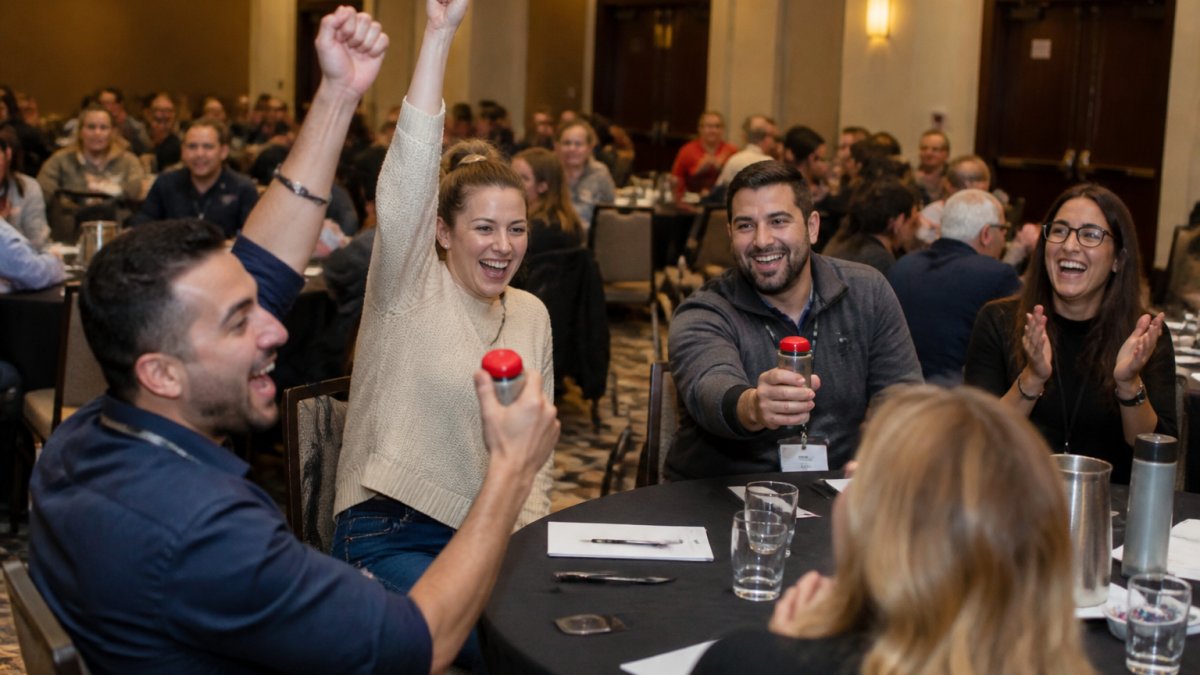
Live trivia and game show formats work because they assign everyone to a team before anyone can opt out. A hosted trivia round with a charismatic MC pulls in the quiet analyst and the loud sales director equally.
The mechanism matters more than the theme. Assign teams of six to eight with a deliberate mix of departments, give each table a single answer sheet or buzzer, and score in rounds of five questions so no team falls hopelessly behind.
Creative, Culinary, and Performance-Based Activities
Cooking workshops and culinary challenges split a group into small teams with a shared task and a visible result. An improv workshop does something similar for communication: participants practice listening and reacting in front of peers, which builds comfort fast. If your group skews small, our guide to creative corporate event ideas for small teams sizes these formats to tighter headcounts.
Designing for Accessibility and Inclusion
Participation collapses when an activity assumes everyone can stand, hear, see, eat, or speak comfortably. Build alternatives into the plan rather than improvising them on the day:
- Mobility: offer a seated version of every physical challenge, a table-based puzzle instead of a room-scale escape, a tasting-and-judging role instead of a relay.
- Sensory: keep music and MC volume moderate, reserve a quiet corner, and avoid strobe or sudden loud effects that can overwhelm guests.
- Dietary: confirm allergies and restrictions in the RSVP, and give culinary teams a non-alcoholic and allergen-safe station.
- Language and cognitive comfort: write instructions on a screen as well as speaking them, and avoid trivia categories that depend on cultural references only some guests will know.
- Social comfort: allow opt-in roles such as scorekeeper or photographer for people who dislike being on stage.
Hybrid and Remote Participation
Distributed teams are now a normal part of retreat planning, and most activity formats can include them with a little forethought. Run trivia through a shared video call with remote players on their own breakout teams, mirror the question screen so off-site guests see the same prompts, and give the host a dedicated chat monitor.
A common pattern is to designate one on-site staffer as the remote liaison so the MC never has to split attention between the ballroom and the screen.
Corporate Event Ideas for Large Groups: Scaling Without Losing the Room
Large-group entertainment fails when the activity only works for the front row. Corporate event ideas for large groups need formats that keep every attendee involved from the back of the room.
Music bingo and hosted game shows scale best.
What most guides miss is the MC problem. For a deeper look at proven formats, see our roundup of team building activities for large companies.
Fun Social Event Ideas That Work Indoors and Across Age Groups
Indoor formats remove weather risk and level the playing field for every age group. Fun social event ideas that hold up indoors tend to be low-physical and high-participation.
- Music quiz or music bingo: grandparents and interns both know the songs
- Interactive magician or comedian: seated audience, no mobility required
- Live painting or live visual artist: something to watch between conversations
- Photo booth: works for every age and doubles as a favor
- Story exchange or story-driven experience: structured conversation that pulls out real stories
Accessibility matters here. Offer a seated alternative for every physical activity, keep aisles clear for wheelchairs and walkers, and brief your host on including non-drinkers and remote attendees joining by video. A hybrid group can play trivia through a shared screen if the host plans for it.
Matching the Activity to Your Retreat Goals and Group Size
The right activity follows from two questions: what should people leave with, and how many are coming? Use this decision framework before you book anything.
- Goal is bonding across departments: trivia, music bingo, or a culinary challenge with mixed teams
- Goal is communication skills: improv workshop or facilitated puzzle challenge
- Goal is celebration: comedian, interactive magician, or DJ-led game show
- Goal is keepsakes and low-key fun: photo booth plus a live visual artist
- Group under 40: escape room, cooking workshop, improv
A common mistake is booking the activity first and inventing the goal afterward. Decide the outcome, then pick the format that produces it.
Budget, Logistics, and Measuring Whether It Worked
Two cost lines catch planners off guard: travel for the entertainer and the labor behind 'simple' activities. Pricing for any format depends on group size, date, venue, and setup time, so treat any range as a starting point and ask for a written quote. For practical ways to keep these numbers under control, read our corporate event entertainment budget tips.
Realistic Budget Ranges
Pricing depends on group size, date, venue, and setup time, so request a written quote from TheMovement315 for current prices.
Total cost of ownership goes beyond the vendor fee. Build these into your number:
- Staffing: an MC or facilitator, plus a technician if the format needs sound and screens.
- Equipment: sound system, screens, buzzers, or props, whether rented or supplied by the vendor.
- Travel and lodging: for out-of-town talent, including mileage or airfare and a hotel night if the event runs late.
- Venue: room rental, power access, and any setup or cleanup fees the venue charges.
- Setup and strike time: paid labor hours before and after the event that rarely appear on the first quote.
Logistics to Confirm in Writing
- Power access and outlet locations
- Load-in and soundcheck times
- Room layout and stage or floor space
- Wi-Fi or cellular signal for tech-driven formats
- Accessibility accommodations for guests
- A run-of-show with activity start and end times
Measuring Whether It Worked
Measure success with what you can observe and ask about, and tie it back to the goal you set before booking. Track attendance at each activity block, collect a two-question post-event survey (one on enjoyment, one on whether the attendee connected with someone new), and note which moments drew the loudest participation. For cross-team goals, ask managers in the following weeks whether their teams are collaborating differently.
Booking Entertainment for Your Next Company Retreat
Booking well comes down to a short, pressure-free conversation about your group, your venue, and your goal. At TheMovement315, we build the entertainment plan around your retreat rather than handing you a standard package.
We bring over 20 years of experience serving Utica, Syracuse, and all of Central New York. Our customized DJ services create a high-energy atmosphere, and we offer interactive photo booths and karaoke as additional enhancements.
If you want the full planning framework behind these ideas, our corporate event entertainment planning guide walks through it step by step. When you are ready to lock in a date, you can review our corporate DJ and MC services and see what fits your venue.
Frequently Asked Questions
What are some good entertainment ideas for a corporate event?
The strongest options split into five buckets: games and friendly competition (company trivia, music bingo, game shows), creative sessions (improv workshops, live painting), food and beverage challenges (cooking workshops, culinary team challenges), performers (comedians, interactive magicians), and technology-driven experiences (VR racing, golf simulators). Pick two or three that fit your goals rather than cramming in everything. A retreat built around collaboration works better with a cooking challenge than a comedian, while a celebration night calls for a game show or DJ-led music bingo.
How do you choose entertainment for a corporate retreat?
Start with the outcome you want: relationship building, celebration, learning, or pure fun. Then match the activity to group size, room setup, and how much participation you can realistically expect. A 20-person improv workshop needs a small space and brave volunteers; a 150-person game show needs a stage, a strong host, and a sound system. Confirm accessibility and noise limits with the venue, then set a budget that covers the activity, host or facilitator, equipment, and any travel fees before you sign.
What interactive activities work well for large corporate groups?
Large groups need activities where everyone can participate at once or in parallel. Live trivia with team tables, music bingo, game shows with audience interaction, photo booths, interactive stations, and VR or golf simulators all scale well because people rotate or compete in teams. Avoid anything that requires one person at a time in front of the whole room. For groups over 100, plan a host or MC to keep energy up and transitions tight, and build in a run-of-show so the room never sits idle.
How can music be incorporated into corporate team building?
Music works as more than background. Music bingo and music quizzes turn song recognition into a team game, karaoke gives people a low-stakes way to perform together, and a DJ-led icebreaker can get a quiet room moving in the first ten minutes. A custom soundtrack also signals when activities start and end, which keeps a retreat on schedule. If you are booking a DJ, share your group's demographics and any songs to avoid so the playlist fits the room rather than defaulting to a generic set.
The hardest part of a retreat is often the entertainment block: too many options, too little time, and a room full of people who will disengage if the format misses. TheMovement315 takes that decision off your plate with a pressure-free phone consultation, customized DJ and MC services, and interactive photo booth and karaoke add-ons built for your group. Get started with TheMovement315 and give your team a retreat they talk about long after the last session ends.