How to Plan Corporate Event Entertainment in 2026
Last Updated: November 6, 2026
Quick Summary
Corporate event entertainment in 2026 is shifting toward interactive formats that rotate throughout an event, keep energy up, and give guests a role rather than a performance to watch. Match the format to your event type and goal first, then match the budget to the format. Measure participation, dwell time, and satisfaction so you can defend the spend.
- Holiday parties work best with a DJ plus photo booth for high energy and keepsakes.
- Place interactive stations where foot traffic already flows and staff them so guests feel welcome.
- A DJ with MC experience usually serves mixed-age crowds and tightly timed programs better than a band.
- Track participation with a headcount at each station every 30 minutes.
- Send a three-question satisfaction survey within 48 hours while the event is fresh.
Table of Contents
- Why Corporate Event Entertainment Is Changing in 2026
- Corporate Event Entertainment Ideas That Match Your Event Type
- Interactive Corporate Event Entertainment That Gets People Participating
- Music for Corporate Team Building: Turning Playlists Into Connection
- Live Music for Corporate Events: When a Band Beats a DJ
- How to Measure Whether Your Entertainment Actually Worked
- Book Entertainment That Fits Your Event and Your Budget
- Frequently Asked Questions
Why Corporate Event Entertainment Is Changing in 2026
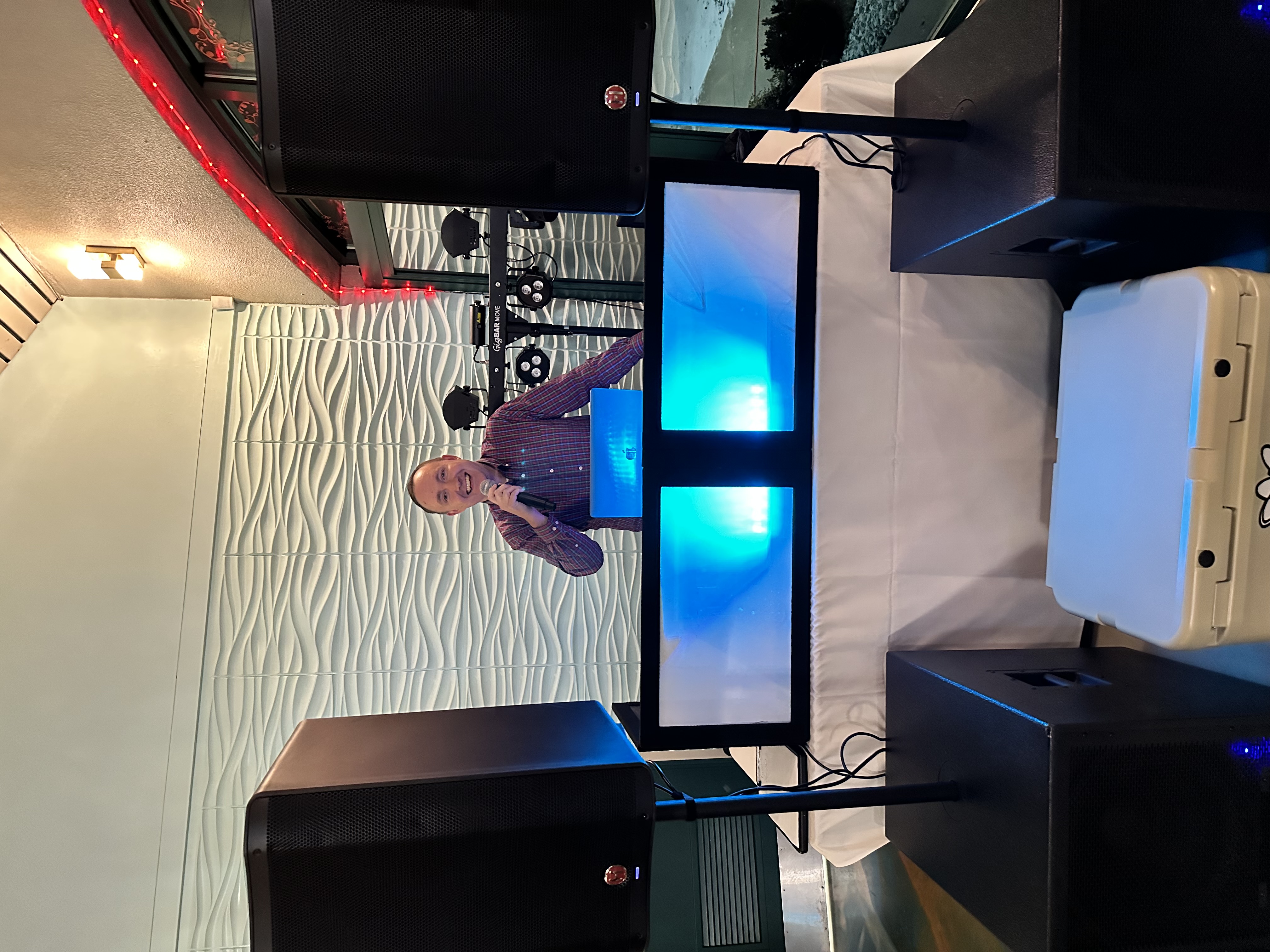
Corporate event entertainment is no longer background music. It is now a core part of how companies communicate culture, retain employees, and make gatherings worth attending. Corporate event entertainment has been reshaping gatherings across Central New York, and TheMovement315 provides DJ services, photo booths, and karaoke for company parties and networking mixers.
The change is driven by attendance pressure. When teams can meet remotely, an in-person gathering has to justify the travel and the time. Entertainment carries much of that weight.
Three forces sit behind the shift in corporate event entertainment trends for the year 2026:
- Shorter attention spans. Long speeches and single-act lineups lose rooms. Events that rotate entertainment keep energy up.
- Experience over spectacle. Guests want to take part, not watch. Interactive formats win over passive ones.
- Proof of value. Budgets are tighter, so planners need entertainment they can defend to leadership.
That last point matters most. Entertainment is often the first line item questioned. The sections below show how to choose formats by event type, how to measure what worked, and how to book within a real budget.
Corporate Event Entertainment Ideas That Match Your Event Type
The right entertainment depends on the room. A holiday party and a product launch want different energy, and treating them the same wastes money. Here is how we map formats to the most common corporate gatherings.
Event Type | Best-Fit Entertainment | Why It Works |
|---|---|---|
Holiday party | DJ plus photo booth | High energy, casual mixing, keepsakes guests take home |
Product launch | Hosted DJ with timed reveals | Controls pacing and builds anticipation |
Networking mixer | Low-volume DJ, karaoke corner | Conversation stays easy, participation stays optional |
Team retreat | Group karaoke, music trivia | Breaks down hierarchy, gets people collaborating |
Awards night | DJ with MC duties | Keeps transitions tight between recognition moments |
A common mistake is booking the biggest act the budget allows instead of the format the room needs.
Match the format to the goal first. Match the budget to the format second. For a deeper planning framework, our corporate event entertainment planning guide walks through the full 2026 process.
Interactive Corporate Event Entertainment That Gets People Participating
Interactive corporate event entertainment works because it gives guests a role. A photo booth, a karaoke stage, or a music trivia round turns attendees from spectators into participants.
Strong participation tends to come when organizers build in three elements:
- A low-pressure entry point. Props, a familiar song list, or a trivia round lets shy guests join without performing.
- A visible focal point. A photo booth or lit stage signals where the fun is happening.
- A keepsake. Printed photos and shared clips extend the event long after the last song.
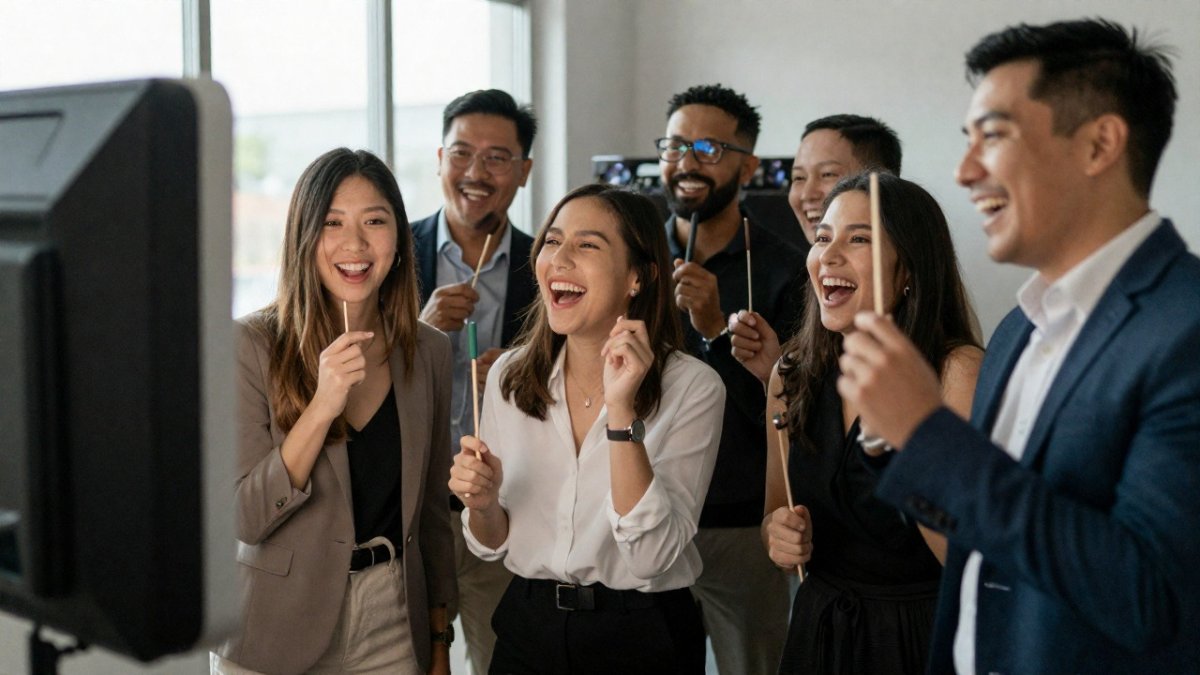
Watch out: interactive stations placed in a dark corner or far from the bar can go unused. Put them where foot traffic already flows, and staff them so guests know they are welcome.
Design for every guest, not just the outgoing ones
Most trend roundups stop at "make it interactive." The harder and more useful question is whether the interaction works for the whole room. A format that only serves extroverts, or that assumes every guest can stand in a loud crowd, quietly excludes a share of your attendees. Accessibility considerations matter for event planning, and inclusive entertainment can also help broaden participation.
Build these considerations into the plan:
- Sensory needs. Loud music, flashing lights, and crowded stations can overwhelm some guests. Offer a quieter alternative, a low-volume trivia table, a seated craft or photo station, or a designated calm area near the entertainment but outside the loudest zone.
- Mobility access. Photo booths, stages, and game stations need clear approach paths, seating options, and controls within reach. Confirm the venue has accessible routes to each interactive area, not just to the main room.
- Language and cognitive access. Trivia and games should have written instructions, simple rules, and options that do not depend on fast verbal responses. Provide materials in the languages your attendee list actually uses.
- Neurodiversity and social comfort. Offer opt-in participation rather than forcing everyone on stage. A team trivia format lets people contribute from their seats, which works better for guests who find performance stressful.
- Hearing and vision. Caption karaoke lyrics and trivia questions on a screen, and use microphones with clear audio for any host-led activity.
Some planners pilot a new interactive format with a smaller group first, watch who hangs back, and adjust placement and rules before the main event.
If you are planning a retreat, our list of interactive entertainment for corporate retreats covers formats built for that setting.
Music for Corporate Team Building: Turning Playlists Into Connection
Music can be a useful tool for corporate team building. A shared playlist, a trivia round built on song clips, or a group karaoke session gives colleagues a low-stakes way to collaborate. The value is not the music itself. It is the shared moment around it.
A team-building session can benefit from a warm-up, a middle challenge, and a closer.
The practical version looks like this:
- Warm-up: a quick "name that tune" round with widely known songs.
- Middle: small-team trivia or a karaoke duet draw that mixes departments.
- Closer: one group song everyone sings together.
For a step-by-step approach, our guide on integrating music into corporate team building covers the full sequence.
Live Music for Corporate Events: When a Band Beats a DJ
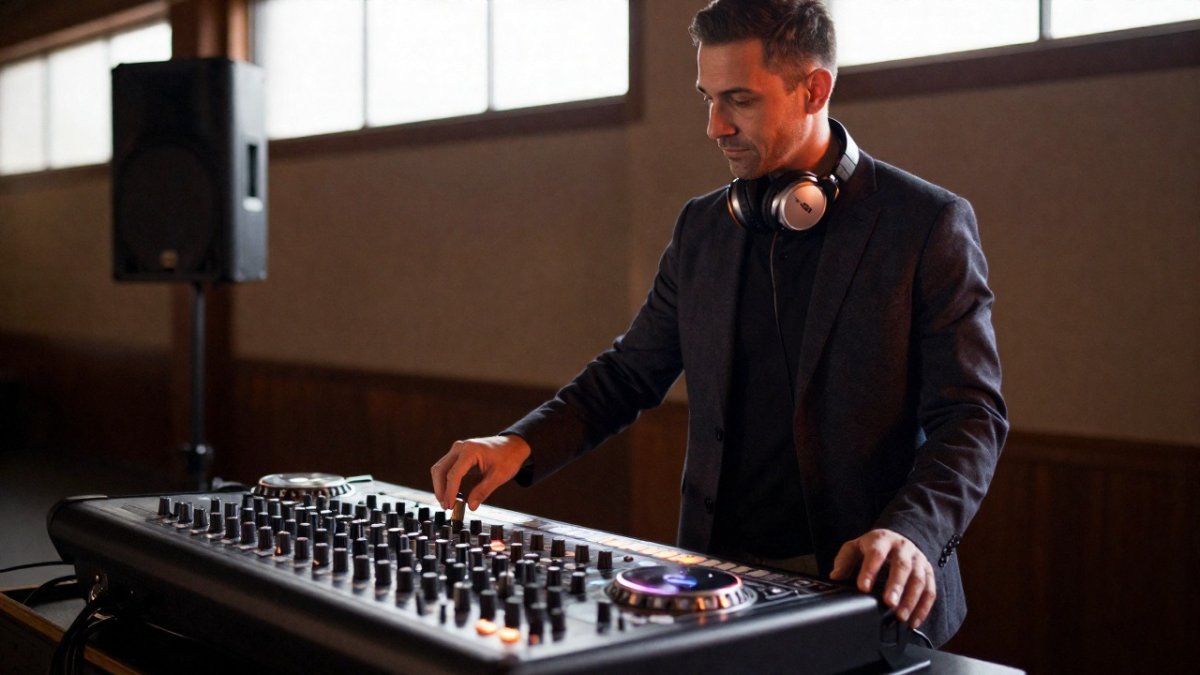
Live music for corporate events wins when the performance is the point. A band suits an awards night, a milestone celebration, or a gala where guests expect a show. A DJ suits everything else: flexible pacing, broad song range, and MC duties that keep a program moving.
A band can deliver energy and spectacle, but it often works within set lengths and a fixed song list. A DJ can adapt to the room during the event and shift between different types of music.
Ask three questions before choosing:
- Does the event need a show, or does it need a soundtrack?
- Does the program have tight timing that requires an MC?
- Will the crowd have mixed ages and tastes?
If the answer to the last two is yes, a DJ with MC experience usually serves the room better. If you are weighing the spend, our breakdown of whether live music is worth the cost compares both options.
How to Measure Whether Your Entertainment Actually Worked
Entertainment can be measured. A short post-event survey and a few observations can help you evaluate the spend and improve the next event. The key is to decide what "worked" means before the event, not after.
Pick KPIs that match the goal
Different events want different outcomes, so the measurement should follow the goal. Use this mapping as a starting point:
- Participation rate, the share of attendees who used the photo booth, sang, or joined a game. Best for team-building and holiday parties where the goal is engagement.
- Dwell time, how long guests stayed through the entertainment block versus leaving early. Best for networking mixers and receptions where the goal is connection.
- Networking activity, observed introductions, business-card or contact exchanges, and conversation clusters. Best for client receptions and mixers.
- Satisfaction, one survey question on the entertainment, scored on a simple scale. Useful for every event type.
- Post-event engagement, shared photos, clips, and social posts that reference the event. Best for launches and awards nights where the goal is reach.
How to actually collect the data
Participation and dwell time are easiest to capture with staff counts at set intervals, for example, a headcount at each interactive station every 30 minutes. Assign one person to that job so the numbers are consistent. Networking activity can be tracked with a simple observation sheet rather than guesswork.
For satisfaction, send a three-question survey within 48 hours, while the event is fresh. Ask what guests enjoyed most, what they would change, and whether they would attend again. Keep the same questions after every event so results are comparable.
Turn the numbers into a decision
Compare results against the goal you set in advance. If participation was low but dwell time was high, the entertainment may have been placed poorly rather than being the wrong format. If satisfaction was high but post-event engagement was flat, the keepsake or sharing step needs work. Write down one change for the next event and one thing to keep. That simple loop is what turns measurement into improvement.
Consistency tends to matter more than sophistication when measuring event results.
Watch out: if you only survey the guests who stayed to the end, you may miss the people who left early, tracking early departures separately gives a fuller picture.
Book Entertainment That Fits Your Event and Your Budget
Budget is a design constraint, not a barrier. Pricing for DJ services, photo booths, and karaoke depends on date, duration, guest count, and add-ons. Contact TheMovement315 through the website for a current quote.
Cost drivers to plan around:
- Date and season. Peak dates cost more because demand is higher.
- Duration and setup. Longer events and complex venues add labor and time.
- Add-ons. Photo booths and karaoke require extra equipment and staffing.
- Travel. Confirm the service area early so there are no surprises.
A common mistake is cutting the entertainment budget last. For practical ways to stretch the spend, our corporate event entertainment budget tips cover where to save and where not to.
When you are ready, contact TheMovement315 for a current quote and to confirm availability for your date.
Corporate event entertainment in 2026 rewards planners who match format to goal and measure what they spend. If you want entertainment that keeps a room engaged from arrival to last song, TheMovement315 brings over 20 years of experience to corporate functions across Central New York, including Utica and Syracuse.
Frequently Asked Questions
What are the biggest corporate event entertainment trends for 2026?
The strongest shifts are toward experience-led design, interactive participation, and personalization. Planners are booking entertainment that pulls attendees in rather than asking them to watch, such as photo booths, karaoke, gamified activities, and music sets built around the crowd in the room. Shorter, higher-energy sessions are replacing long staged performances, and Wellness-friendly formats and inclusive options that work for mixed-age and mixed-ability audiences are also growing.
What interactive corporate event entertainment works well for a company party?
Photo booths, karaoke, trivia, and music-driven games tend to get the highest participation because they are low-pressure and social. The key is matching the activity to the room: a 150-person holiday party needs entertainment that scales and keeps lines moving, while a smaller networking mixer benefits from activities that spark conversation.
How do I choose entertainment for a corporate event?
Start with the goal, not the act. Decide whether you want networking, celebration, team bonding, or brand impact, then pick entertainment that serves that outcome. Match it to your audience's age range and energy level, confirm the venue can support it (power, space, noise limits), and set a budget that accounts for the main act plus any add-ons. Ask about the energy and playlist approach before you commit, and confirm how your music requests and content restrictions will be handled.
How long should entertainment last at a corporate event?
Most corporate events work best with entertainment split into blocks rather than one long stretch. A common approach is a short welcome set, a longer main block during dinner or peak social time, and a high-energy close. Shorter sessions tend to hold attention better than a single multi-hour performance. For a typical evening party, plan entertainment around the length of the event, with interactive elements like a photo booth available throughout so guests can join when they want.