How to Keep Guests Engaged During Event Transitions
Last Updated: November 20, 2026
Quick Summary
Keep guests engaged during event transitions by announcing what comes next, keeping background music playing, giving people a small task, and assigning one clear owner to every handoff. Build a run of show that maps each transition with a set time limit and a backup cue. Short gaps of two to five minutes hold attention best when the room never goes silent.
- Tell guests what is coming before each change to give them a reason to stay.
- Keep background music running so the room never feels empty during resets.
- Build a run of show that lists every transition with one named owner.
- Set most reset moments between two and five minutes, and test timing in a walkthrough.
- Add a five to ten minute buffer and mark transitions as hard or soft.
Table of Contents
- Why Event Transitions Lose Guests and How to Prevent It
- Building a Run of Show That Maps Every Transition
- Using DJ Announcements to Guide Guests Between Segments
- Event Transition Ideas for Weddings, Proms, and Corporate Events
- Engagement Activities That Fill Gaps Without Dragging the Room
- Keeping Every Guest Included, from Grandparents to Teens
- Booking Your Next Event's Transition Plan
- Frequently Asked Questions
Why Event Transitions Lose Guests and How to Prevent It
Event transitions are the moments between segments, when guests move from dinner to dancing, from a ceremony to cocktails, or from a speech to a game.
Most transitions lose guests for a few predictable reasons. The room goes silent while staff reset tables. Guests do not know what happens next.
Here is what helps most:
- Tell guests what is coming. A short announcement before each change gives people a reason to stay.
- Keep sound running. Background music, even at low volume, stops the room from feeling empty. Learn how to pick tracks that carry guests smoothly through each change in transition-friendly playlists.
- Give people something small to do. A simple prompt keeps hands and minds busy during resets.
A common mistake is treating transitions as dead time. Treat them as part of the event instead, and plan them with the same care as the main moments.
Building a Run of Show That Maps Every Transition
A run of show is a minute-by-minute document that lists every segment, every transition and every person responsible for it. For a deeper, pro-level guide to managing each handoff between segments, see Managing Event Transitions Like a Pro.
Build your run of show in four steps:
- List every segment in order, from doors open to final song.
- Mark the transition between each pair of segments.
- Assign one owner for each transition, such as the emcee, the DJ or the venue coordinator.
- Write the exact cue, such as a song title, a spoken line or a lighting change.
Share the document with everyone who touches the event. Vendors, venue staff and family members should all know the order. Print copies for the DJ booth and the coordinator, and keep a digital version on a phone.
A Transition-by-Transition Run of Show
Most guides stop at "make a timeline." The practical version maps each handoff separately, because arrivals, room changes, meal service, speaker handoffs, breaks and closing moments each fail in different ways. Use this structure as a starting template and adjust the times to your event.
| Transition | Typical window | Owner | Cue | Backup if it slips |
|---|---|---|---|---|
| Doors open to welcome moment | 15-20 min | Emcee or host | Upbeat playlist at moderate volume; welcome line at the scheduled minute | Hold the welcome until the room reaches roughly two-thirds capacity, then start anyway |
| Welcome to first activity | 2-3 min | Emcee | One-sentence handoff plus first song or first prompt | Start the activity with whoever is seated; late arrivals join in progress |
| Activity to meal service | 3-5 min | Venue captain | Music continues; servers enter on the captain's signal | If the kitchen runs late, run one short table game before service |
| Meal to speeches | 2-4 min | Emcee | Microphone check, then a short intro line | If a speaker is missing, move to the next speaker and return later |
| Speech to speech | 30-60 sec | Emcee | Name the next speaker and their relationship to the event | If a speaker runs long, the emcee gives a 30-second warning card |
| Speeches to dancing | 3-5 min | DJ | First dance song starts as tables clear | If the floor is slow to fill, open with a group song or line dance |
| Dancing to break or dessert | 2-3 min | DJ and venue captain | Music drops to background level; dessert station announced | Keep one upbeat song playing to avoid a silent room |
| Break to next segment | 2-3 min | Emcee | Countdown or two-song warning before restart | If guests linger, send staff to tables with a direct invitation |
| Final segment to closing | 3-5 min | Emcee and DJ | Closing song, thank-you line, exit instructions | If guests leave early, move the thank-you earlier rather than cutting it |
Two rules make the table work. First, every row needs a named owner, not a role like "staff." Second, every row needs a backup cue that can run without the original plan. A run of show that only works when everything goes right is not a run of show; it is a wish list.
Watch out: a common failure is assigning the same person to own two adjacent transitions, which leaves no one free to troubleshoot when the first one slips.
Setting Timing and Duration for Each Transition
Each transition needs a time limit. Most reset moments work best between two and five minutes. Longer gaps lose attention, and shorter ones may not give staff enough time to move tables or equipment.
Consider these starting points:
- Dinner to dancing: three to five minutes, with the first song playing as tables clear
- Ceremony to reception: five minutes, with a short announcement and background music
- Speeches to games: two minutes, with the emcee introducing the next activity right away
Test your timing during a walkthrough. Time how long the room reset takes, then add a small buffer. If a reset consistently runs over five minutes, the problem is usually staffing or layout, not the schedule.
Planning Contingency Time for Delays
Delays are normal. A toast runs long, a guest needs a microphone, or the kitchen runs behind.
Keep a backup plan ready. If the planned game cannot run because of space or a last-minute change, have a simpler activity you can start immediately.
A useful habit is to mark each transition as either "hard" or "soft." A hard transition has a fixed time, such as a ceremony start or a plated dinner.
Using DJ Announcements to Guide Guests Between Segments
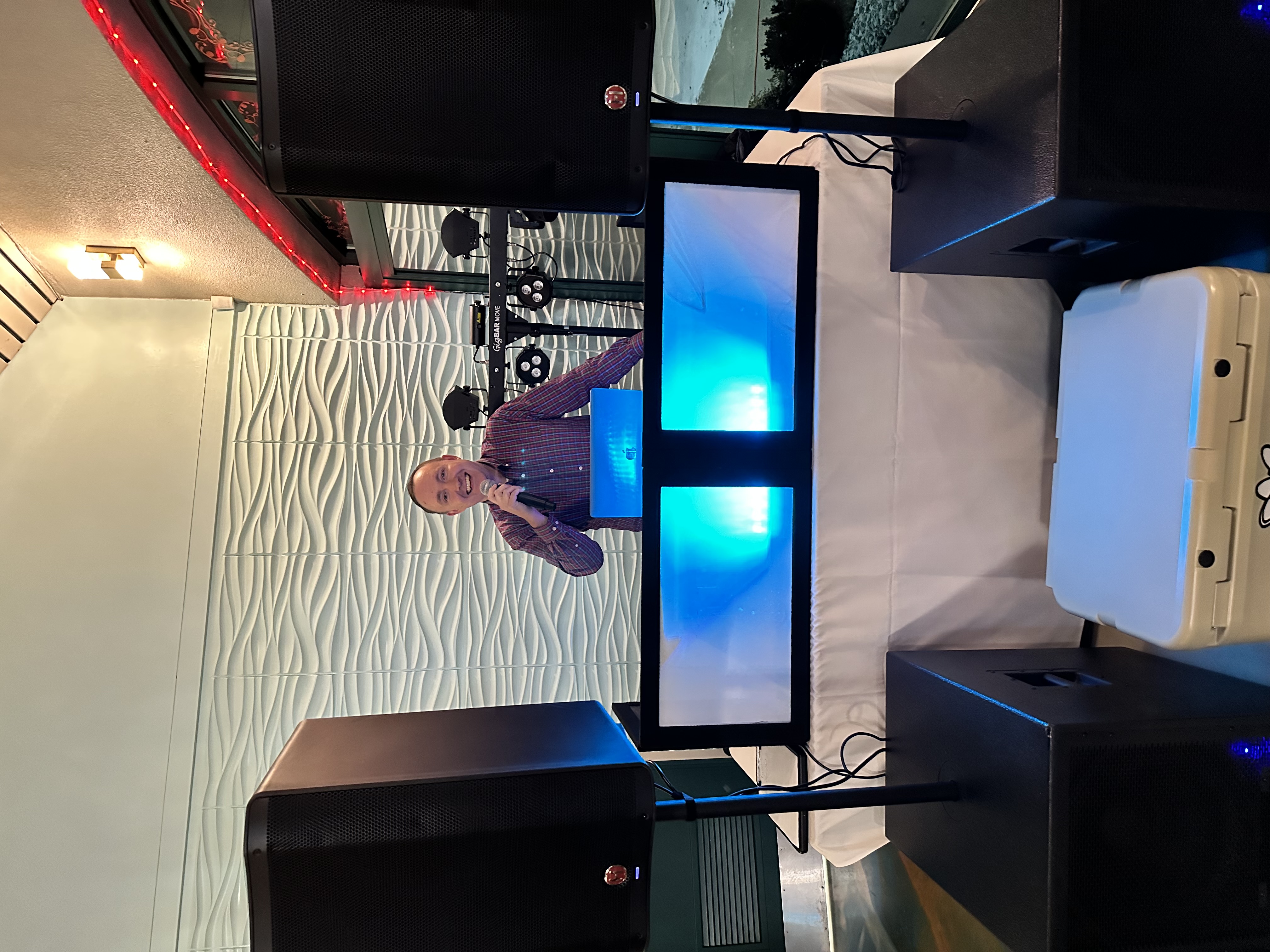
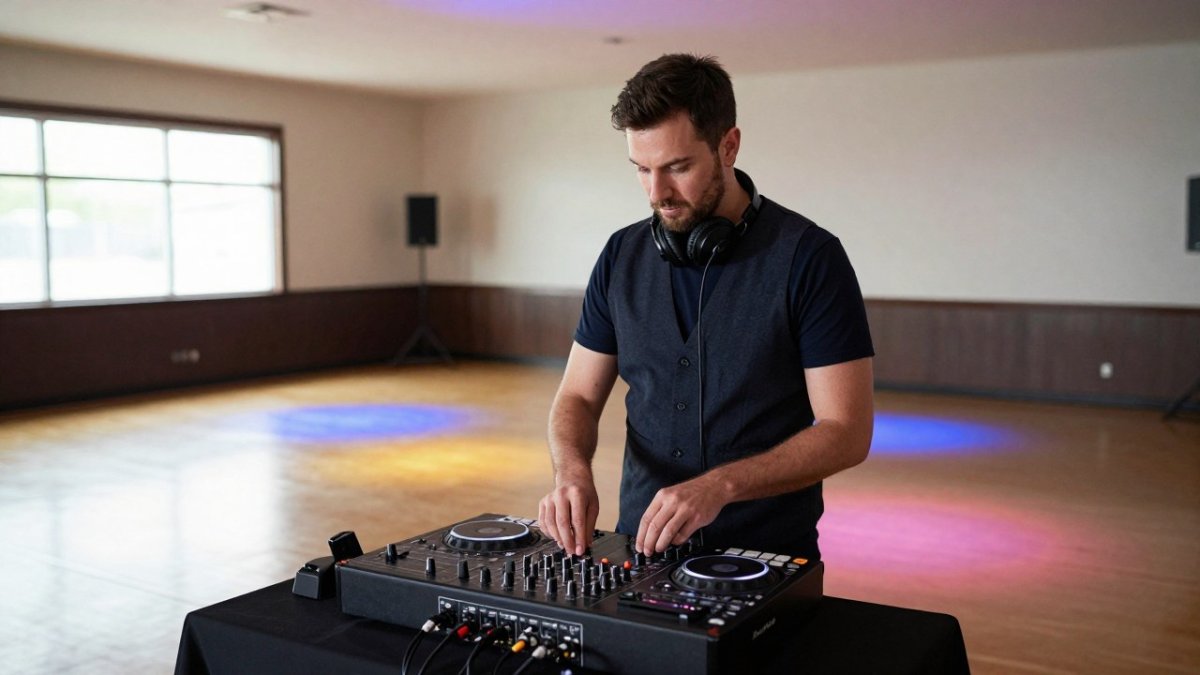
Announcements are one of the most effective ways to move a room from one moment to the next. A DJ with a microphone can explain what is happening, invite people to the dance floor and keep energy high while staff work behind the scenes.
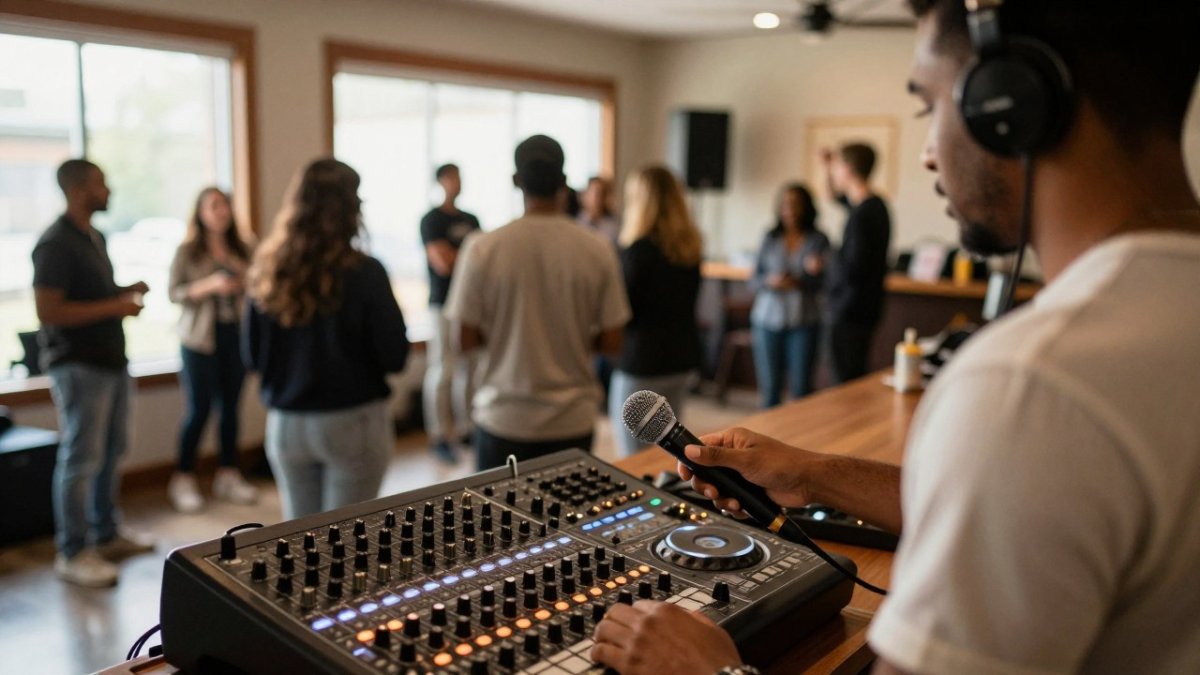
Keep announcements simple:
- Name the next moment: "Dinner is wrapping up, and the dance floor is open."
- Give one clear action: "Grab your partner and head to the floor."
- Keep it under twenty seconds.
Time your announcements to the music. Start speaking as one song fades into the next, so the transition feels continuous rather than interrupted. For timing music and announcements to presentation or segment cues, see how to coordinate music with presentation cues.
Event Transition Ideas for Weddings, Proms, and Corporate Events
Each event type calls for different transitions. Match the tone and the crowd.
Weddings: Use the first dance or cake cutting as a bridge.
School proms and dances: Students respond to quick, high-energy changes. For practical, budget-conscious planning for a school dance, see how to plan a school dance on a budget.
Corporate events: Attendees often want clear direction.
Across all three, keep the music on and the next step visible.
Engagement Activities That Fill Gaps Without Dragging the Room
Engagement activities work best when they are short and easy to join. The goal is to fill the gap, not to create a new event.
Examples that fit a short gap:
- A quick trivia question about the couple, the class or the company
- A photo challenge where guests post pictures to a shared screen
- A line dance or group song that takes under three minutes
Choose activities that match the room. Avoid anything that asks guests to stand in a long line or wait for a turn. Plan one activity per transition at most, and have a fallback ready if the room is not responding.
Low-Cost and Low-Tech Options
Performers, elaborate decor and production technology are not available to every event, and they are not required to keep a room engaged. These options need little or no special equipment:
- Table prompts: printed cards with one conversation question, placed before guests sit down.
- Group photo moment: a single announcement asking everyone to raise a hand or a phone for a shared photo.
- Two-song countdown: the DJ announces that the next segment starts in two songs, which gives guests a clear return cue without any production.
These options also work in venues with limited space, no stage and no reliable internet. If a venue has poor connectivity, skip anything that depends on a shared screen or an app and use printed or spoken prompts instead.
Matching the Activity to the Audience
The same activity can land differently depending on the crowd. A few adjustments:
- Corporate conferences: use short networking prompts and agenda reminders rather than games. Attendees want direction and a reason to talk to someone new.
- Weddings: lean on the couple's story for trivia and use the photo booth or a group song as the bridge between dinner and dancing.
- Fundraisers: use the raffle or a brief mission story during resets, and keep the program moving so donors stay in the room.
Knowing Whether an Activity Is Working
Engagement is easier to judge than it feels. Watch a few observable signals during and after each transition:
- Participation: how many guests join in versus stay seated or on their phones.
- Dwell time: how long guests stay in the room before drifting toward the bar or the exit.
- Return-to-seat rate: how many guests are back in place when the next segment starts.
Use these signals to adjust the next transition, not to grade the last one. If participation is low, shorten the activity or switch to a seated prompt.
Accessibility matters as well. Use captions or printed cues for announcements where possible, keep activities optional so no one feels pressured, and make sure any movement between spaces is clear for guests who use mobility aids.
Keeping Every Guest Included, from Grandparents to Teens
Mixed-age rooms need activities that work for everyone. A dance-heavy plan may leave older guests waiting, while a quiet game may bore younger ones. Mix the two.
Some practical options:
- Offer seated activities alongside dancing, such as a trivia round at tables.
- Play a mix of song eras during resets, so every generation hears something familiar.
- Give guests a choice, such as joining the dance floor or the photo booth.
Accessibility matters as well. Use captions or printed cues for announcements where possible, and keep activities optional so no one feels pressured.
Booking Your Next Event's Transition Plan
A strong transition plan starts well before the event. Map every segment, assign owners, set timing and prepare a backup for each gap. Then review the plan with your DJ, emcee and venue team at least one week ahead.
If you want help building a run of show or planning announcements for your next wedding, prom or corporate event, reach out to TheMovement315 for a pressure-free phone consultation.
Frequently Asked Questions
How long should an event transition or activity break last?
Most transitions should last between two and five minutes. Shorter breaks keep momentum, while longer ones let attention drift. For a wedding, moving from dinner to the dance floor usually works best in about three minutes with a clear announcement. Corporate programs can allow slightly more time for a speaker handoff. Build the duration into your run of show and add a buffer of about 10 percent so a late guest or slow setup does not push the rest of the night off schedule.
How can a DJ make transitions between event activities feel seamless?
A DJ keeps transitions smooth by bridging music, not stopping it. Use a song with a familiar hook to signal the change, lower the volume gradually, and speak over the intro rather than the vocals. Give a short announcement that names the next activity and tells guests where to go. Confirm cues with the emcee or planner beforehand so the handoff happens on time. Rehearsing two or three key moments with the planner prevents awkward silences.
What can guests do during downtime at an event?
Downtime works best when guests have a simple option. Set up a photo booth or karaoke station, offer a short group game such as a trivia round, or invite guests to sign a guest book or leave a video message. For mixed-age crowds, pair a light activity with a music request opportunity so everyone has a way to participate. Keep options visible and low-effort so guests can join without feeling put on the spot.
How do you keep wedding guests entertained between the ceremony and reception?
Keep the gap short and give guests something to do. Play upbeat background music, open the photo booth or a karaoke station, and have a host or DJ share the timeline so guests know when the reception begins. If the wait will be longer than 30 minutes, add a simple activity such as a guest signature board. Clear communication about the schedule prevents guests from drifting or leaving the venue.